

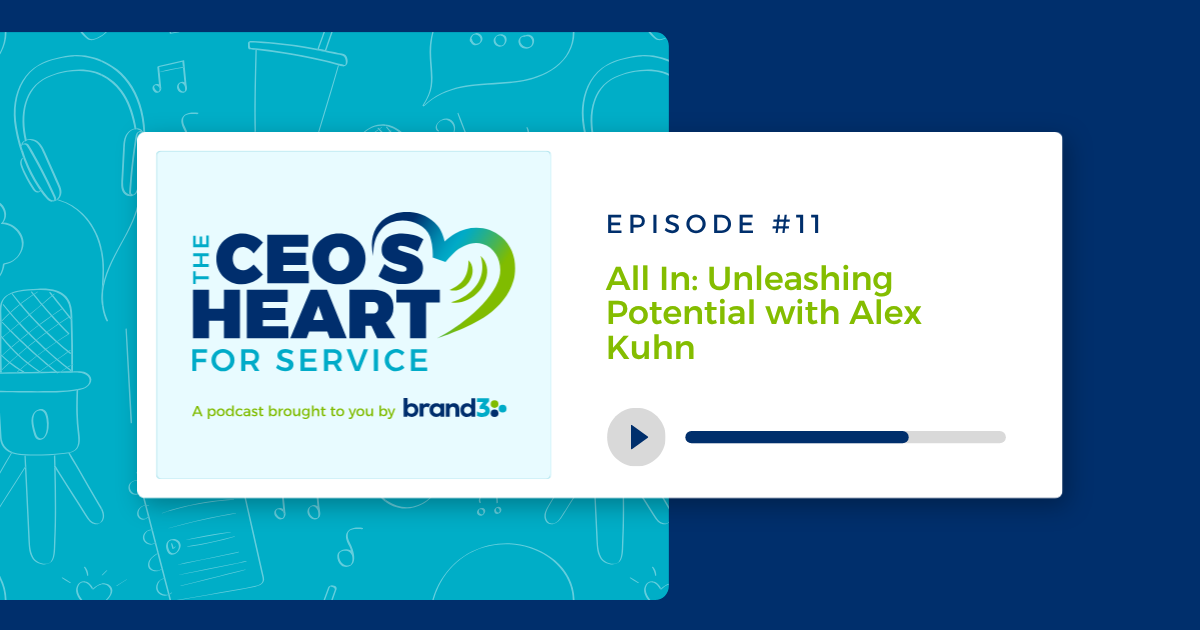
What if the fastest way to grow your business isn't through better ads or more AI tools, but through the courage to actually be seen? On this episode, Matt Wolfe and Orsi Herbein welcome Alex Kuhn, founder of All In, for a conversation about why human connection, partnership, and being the face of your brand might be the real unlock for scaling a service-based business.
0:00 – Intro & Welcome
1:20 – Meet Alex Kuhn
5:12 – Alex's Origin Story
7:58 – What All In Does
12:27 – Human Connection vs. AI
16:16 – Access to Activation
19:23 – Hidden Opportunity and Niching
26:03 – FOMO and Going Narrow
30:54 – Heart for Service
35:46 – Values and Scaling Tension
37:13 – Values Set Boundaries
38:00 – Intuition Over Logic
39:20 – Failures and Ownership
41:26 – Decide Fast, Go Now
42:35 – Frameworks Not Systems
46:18 – Perfection Myth
48:42 – Behind the Brand Quiz
58:33 – Success Means People
1:02:51 – Scale Beyond Referrals
1:01:42 – How to Reach Alex
There's a tension every leader of a B2B service has to navigate: How do you scale without compromising the quality of your services - or the values that drive them? The CEO's Heart for Service is where accomplished B2B leaders share hard-won insights on walking that tightrope.
The CEO’s Heart for Service is a production of Brand3. If you’re a B2B service provider who delivers exceptional service but struggles to get your marketing to connect with the right people, find us at brand3.net. And sign up for our Brand3 Newsletter that only sends marketing insights worthy of your inbox - genuinely helpful stuff for the road ahead.
The CEO’s Heart for Service is also supported by Forge Podcast Company, a turnkey production solution for using podcasts to reach a wider audience, win new clients, and grow. Find them at forgepodcast.co
Matt Wolfe: Hi everybody. Welcome back to The CEO's Heart for Service. I'm Matt Wolfe, a partner at Brand3, and it's a big day because I finally have my other business partner, Orsi Herbein, here with us. She is a founder of Brand3 and an amazing human being. You may have seen her interviewed on the show before, but this is the first time she gets to co-host with us. Hi, Orsi. How are you?
Orsolya: I'm doing well. How are you?
Matt Wolfe: I'm good. Podcast days are always fun days. We get to meet great people, and I'm always happy when I get to spend a little more time with you. When we do these co-hosting episodes, we get to know our guests better and each other a little better too. It's a good thing.
Orsolya: It's all about relationships, right?
Matt Wolfe: All about relationships, which we will talk about today.
Matt Wolfe: We are talking to Alex Kuhn today. He is the founder of All In, and we will explain more about what that is as we go along. He helps businesses where there is a face of the brand, helping those businesses develop new programs that can really help them scale and grow. Orsi, what are some of the things you took away from today, or that surprised you, that you are excited for people to hear?
Orsolya: So many things, but it's weirdly this one thing that Alex said about talking to his son in the morning and asking, "Are we gonna be good or are we gonna be better?"
Matt Wolfe: Yeah
Orsolya: I loved that line so much. I can't wait to share that with my g- girls when I go home because I think I have a tendency to push for good, but I really see the value of just being better than yesterday,
Matt Wolfe: Mm-hmm.
Orsolya: And then tomorrow being better than the day before. Just always striving for the next level up. That was really cool to hear. But there were so many things. Alex is incredible.
Matt Wolfe: He has incredible insights. What I am most excited for the audience to hear is this: Alex is really good at questioning the status quo. He is growing his business and serving clients in ways that cut against the grain, that work against the current of conventional wisdom. As you hear him explain it, you are going to learn just how powerful the right insights can be. We need people in our lives and in our industries who ask: is that really how it always has to be done? Does it have to work that way? Alex is asking those useful questions, and I think they are going to open people's horizons about how they can scale their services and grow.
Without further ado, let's hop over and introduce you to Alex Kuhn. Alex, welcome to the show. We are so glad you are here.
Alex Kuhn: Hey, love being here. You know how much I love you. Um, appreciate you.
Matt Wolfe: Full disclosure, we have been working with Alex as our coach, and we are so happy to have him here today. I had the good fortune of meeting him through Catherine Brown and the Good Humans Network. The Grow Conference in Texas is where we first connected, and I would highly encourage people to look up both of those things.
What we discovered in Alex was not only someone with tremendous knowledge and insight, but someone with tremendous heart and integrity. I am excited for people to experience that today.
As we dive in, you know as well as anyone that we have a program launching called Scale Beyond Referrals. It is built around the idea that when you are offering a high-trust, high-stakes B2B service, whether that is in finance, tech, strategic consulting, or any space where you are asking someone to let you take care of a critically important part of their business, everything about selling and moving those conversations forward comes down to relationships, trust, and getting to meet the human behind the brand. Who is the person you are actually going to trust with something this important, beyond just the knowledge and expertise they bring?
With that in mind, we always like to get to know the person behind the brand while we have these conversations. And the first question we like to ask is a fun one. You are now doing incredible work guiding businesses like ours through growth strategies of all kinds, but that is probably not what you pictured for yourself when you were growing up. So what did you want to be? Where did you think life was taking you when you were younger?
Alex Kuhn: When I was a kid, I had a few different ideas at different points in my life. I want to share two of them, and one is going to make you laugh because it will probably give you a little insight into why I speak and coach the way I do.
The first one I remember is wanting to be a professional baseball player. Specifically, the second baseman for the Florida Marlins, which I cannot fully explain. I loved baseball, and I was a Pittsburgh Pirates fan, but for some reason the Florida Marlins just seemed cool to me. They were in a sunny place, their uniforms were way better, and they had that big fish on them.
I can remember spending hours behind my house with a tennis ball, making up these elaborate imaginary games where I worked my way up through the minor league system and eventually became the starting second baseman. And then, true story, aliens came down with their best baseball team, and it was my job to be the superhero who saved the day. Which, as a hint, tells you quite a bit about how my imagination works.
Matt Wolfe: Right
Alex Kuhn: That was the first career. The second one, funny enough, was this: I was not a kid who listened to popular music. While everyone else was into MC Hammer and everything that was cool at the time, I was listening to motivational speakers. Tony Robbins, Les Brown, Jim Rohn, Dexter Yager, all of those people. That is what I had growing up.
So I wanted to be a motivational speaker. I had no idea what that really meant. I just knew I thought it was cool that these people stood on stages and talked to rooms full of people. There was always this dream of being in front of an audience, being Tony Robbins-esque. You can probably see why I ended up going down the career paths I did, given those early inspirations.
Matt Wolfe: That is fascinating. After all the hours we have spent together, that has never come up. And yet it was so deeply woven into who you were becoming. Also, you just carbon-dated yourself with the MC Hammer reference, so now we know exactly where we are in history. I am right there with you though, so we are on the same page.
Alex Kuhn: I tried to get my kids into The Presidents of the United States the other day. I was telling my wife about them, and she is four years younger than me. She looked at me and said, "Who is that band?" I could not believe it. Do you not remember the song Peaches? I just gave up. We are on the Taylor Swift train now. Ophelia is into it, so that is where I am.
Matt Wolfe: My little guy is three years old, so my current mission is figuring out how much eighties and nineties culture I can cram into him before he eventually rebels. We will see how that goes.
Orsolya: Alex, let's start with the basics. Tell us about All In: what do you do, and who do you serve?
Alex Kuhn: Orsi, I want to say something, and this is not a shameless plug; this is the honest truth. Matt mentioned at the start that the three of us have been working behind the scenes together as you have built this. My team and I have built roughly 95 new programs this year with one-on-one clients and group programs combined. What Orsi and Matt have built, based on their talents, their skills, the value behind it, the perception, and the genuine need for it, is literally one of my top five favorites this year. It has been such an honor to work with both of you and to watch the best parts of yourselves come to life.
At the core of where I come from, I am not a business guru or a high-profile former CEO. I was a college swim coach who ended up becoming one of the top college swim coaches in the country before stepping into entrepreneurship. And what I have found is that my favorite part of this work really comes down to three things.
The first is that I am the biggest raving fan of people who decide to be the face of their business. Call it the Rocky syndrome. I grew up watching that underdog story, and I personally believe, and it has been proven time and again, that when you are the face of your business, whether you call yourself a personal brand, a coach, a real estate agent, it does not really matter, it is the best path to financial freedom, the best way to attract clients, and truly the best way to build relationships with people who appreciate you and genuinely enjoy working with you.
That is why I named my company All In. If you have the guts and courage to put yourself out there as the face of your business, you are opening yourself up to ridicule, challenges, and imposter syndrome. It is not just about business. It is about you growing as a leader. And what that tells me is that I want to make sure you succeed. I have been fortunate enough to do that for myself and hundreds of others, and I want to make sure that everyone who puts their good heart out there succeeds.
The second thing I am a core believer in is that the best way to grow is through partnerships. In a world where everyone keeps talking about AI, paid ads, and all the latest mechanisms, what you actually see when you look at the best businesses in the world is that they grow through founders merging, through people getting together and building incredible events, through human beings coming together and creating something bigger than themselves. It is not the ad or the social media algorithm doing the work. It is people.
The third thing that is truly important to me is performance. Call it the athlete in me, or the swim coach in me. I do not even really like calling myself a coach in the business world, because to me a real coach is there six days a week, morning and evening, working on academics, goals, vision, and self-sacrifice. In the business world, too many coaches show up once a week, have a conversation, and say See you next week. I do not run my programs that way, and honestly, I kind of hate that model.
For me, performance means helping someone build a culture, build a strategy, and then actually following up with them day to day, week to week, month to month, year to year, until that client hits their vision and their goal. The only metric I really count in my world is second contracts. I am proud that 81% of our clients choose to keep working with us, either in group programs or one-on-one. That is the number that matters most to me.
Orsolya: It's amazing.
Orsolya: Listening to you, I love how aligned we are on this idea that human connection is worth fighting for. It is so important. We are being taken over by robots left and right. I have a friend who just ordered Neo, an artificial humanoid robot that apparently does your laundry among other things. I showed it to my 15-year-old, and she looked at me and said, "Mom, that's wrong. This is scary." She was worried about people being mean to the robots. And honestly, have they not watched WALL-E?
Alex Kuhn: Yeah,
Orsolya: Anyways, it's coming. But I think at the end of the day, human connection is worth fighting for. And, you know, it, it... You know our business, but, you know, Brand3 is also about championing that. So
Alex Kuhn: That is exactly why I love working with you. I actually have what some might call a controversial take on AI and robots and all of it. I believe it is going to do two things.
First, I believe AI is actually going to enhance the importance of human connection. It is going to deepen the value of understanding your own emotions, your own feelings, your own heart, and your own vision. The skills that were once just natural parts of how we operated, before all the technology, I think are going to become more profound. Because what I see happening is that parts of the world driven entirely by AI are going to stop thinking for themselves and stop feeling for themselves. And while there is a place for any technology, I still believe it is an accelerator. It accelerates the right things, but it can just as easily accelerate the wrong things.
The people who hold onto human connection, who figure out how to maintain and grow it while also using AI as a tool, those are the people who are going to succeed. Those are the people who will still find fulfillment and continue to grow. The people who go all in on AI alone, I genuinely have concerns for them.
Matt Wolfe: Absolutely. We have found so much resonance with you in how we talk about scaling and growth. And as Orsi said, it really does come back to celebrating human connection.
What you just shared also cuts against something a lot of founders have assumed for years. If you are the founder-led face of a B2B service brand, there has been enormous pressure to believe that you need to step back and disappear so that some big, polished brand can take your place. That the brand is what gives you authority, not you.
But the thing that actually makes you great is who you are, what you bring, and the humanity you have built into the brand. That is what people are truly looking for. And it gets buried so often.
The same is true for what you said about partnerships. Part of the pressure to become this big recognizable thing is the belief that you have to go it alone, that you have to supply all the value yourself. But there is so much more strength in partnership. If we are honest, people want to know other people, and they want to know communities. We find more safety and security knowing that someone is partnered with others who are genuinely good at what they do, that we are stepping into a network of support rather than a solo act.
There is so much in what you are bringing to this conversation that runs against the current in the most helpful way.
Alex Kuhn: One of the things I find, Orsi, is that we talk a lot about heart and human connection and the impact of giving and being present with people. And we hear these expressions around partnerships and networking all the time. It is not what you know; it is who you know. You are the average of the five people you spend the most time with. These things have become clichés because there is truth in them.
But here is where I think a lot of people get stuck. When it comes to partnerships, access is only one step of the process. Having the idea that you want to build referral partnerships, strategic partnerships, or brand partnerships, and then actually getting access to those people, that is one thing. But most people do not understand that there is an activation side to access.
It is not just about being a great person and building a genuine relationship. It is about understanding how to actually create something that the person on the other side wants to be part of, something of tremendous value for the market or for their community. It is about knowing how to structure a 30-minute conversation so that it is not just coffee and vague promises, but something that can genuinely move your business forward. You can create something significant in a single 30-minute conversation without waiting years for it to materialize.
One of my bigger missions is addressing this: too many people spend money on masterminds and networking events and organizations, and they are told they have to wait years before a relationship finally pays off. My question is, why? Why can't you create something meaningful with someone you just met? Why can't you grow something in this moment? That is the paradigm shift I hope for. Access is the starting point. Activation is what makes it work. And when you truly understand that, I believe it is the fastest way to grow.
Orsolya: It just makes so much sense. But I do think there is a lot of talk right now about the who, not the how. And part of the problem is that there is so much available, so many books, so many masterminds, so many options, that it is genuinely hard to figure out what to choose and what is actually worth your time.
I think this is exactly where activation meets clarity. You have to be able to clearly articulate what you need and what you actually deliver. Even if you have access to the right people, the ones who could genuinely move the needle for you, if you cannot communicate what you need from them, it is probably not going to go anywhere. Access alone is not enough.
Matt Wolfe: That is why we put so much emphasis on the very first thing we do in our program. We call it finding the hidden opportunity, and what we are really talking about is defining your ideal client. Not just who you are best suited to serve on paper, but in heart, in connection, in values. Who are the people that, when you work with them, get the best results, where your team clicks on all cylinders, and everything just works?
The reason I highlight that is that so many of the other choices we need to make, including sorting through all the books, all the advice, all the options you mentioned, flow from that one north star: knowing who you serve. We tend to avoid making that choice because we are afraid it will limit us. But the paradox, the actual truth of it, is that it is expansive. It is liberating. Once you have decided who you are going to serve, you are free.
And Alex, what I think you are so good at is taking someone from that moment of having decided who they serve and helping them figure out exactly how to do it. I want to make sure people hear clearly what you are offering, because I am sure they are already responding to everything you have to say. Tell me if I have this right: you help people who are the face of their brand build new programs that allow them to grow their business and serve more people with heart.
Alex Kuhn: Yes, very much. Actually, I want to turn the question around on you two for a moment, because I think you are the voices people need to hear on this.
Alex Kuhn: We decided to change our company name. Behind me, you can see Born to Lead, and that was our original brand name. I still love that name. The quick origin story is that I needed to move away from how I was doing business into how I actually wanted to do business. When I went through a branding exercise at the time, the person working with me heard a story about how angry I got when a coach and my dad once said, even jokingly, that I was just being a follower. I was furious. I am a leader. And I think there are just people who are born to lead. That name is still dear to my heart.
But the reason we changed it comes back to something you said, Orsi, about how you choose. That is the point. Here is my simplest way to think about brand building, making more money, and making more impact. It comes down to one equation. What are you all in on? What do you want to do, what do you want to say, what do you want to offer, and how do you want to do it, with no compromise. And then on the other side, who is going to be all in with you? What is the vision they have? What do they need? What do they actually want solved?
So when I put that together, All In is not just a motivational statement or a reason I changed my brand name. It is a core methodology. I genuinely believe most people struggle because they do not choose and they do not commit. And honestly, you two might not even know this, but every framework I have built is based on four questions. When you get someone to answer those four questions in the right way, you get higher levels of commitment from them and higher levels of commitment from yourself. It is embedded in our messaging systems, in how we build programs, in how we sell and market, in how we run day to day, and in how we measure success. The same equation every time. That is how I maintain coherency and consistency. But you said it perfectly, Orsi. That is the big thing.
And Matt, I want to ask you both: why do you think so many people are missing that hidden opportunity? I think your audience needs to hear your answer to that.
Matt Wolfe: I can tell you what I think, because it connects directly to what you just said about making choices. Choices scare us. When we do a presentation on Scale Beyond Referrals, there is a slide in really big print that says: make strong choices. That phrase came from the theater world for me.
One of the places you and I bonded, Alex, is that we both came into this world from unexpected directions. You from athletics, me from the arts and professional theater. When you watch a great actor, someone you genuinely believe, someone you fall into the performance with and think, I really believe they are that person, what is behind that is not magic. It is that they made really clear, strong choices. Another way to say it is they had a clear strategy for how they were going to communicate the script, live in that moment, and interpret the character.
As an actor, I always found it hard to sit down and start making choices about who my character was, what he wanted from the other person in the scene. You worry you are going to make the wrong choice. But here is the truth about acting: you have to make your choices up front. You have to come to rehearsal and onto the stage with something. And then the second piece is equally important. You have to listen. What kills a performance is when an actor stops listening to their scene partner. You make the strong choice, you step onto the stage, and then you catch what the other person is giving you, and you stay open. You trust that the work you have done is there, that you know who the character is and where the scene is going. But if you try to force your predetermined idea of what the scene is supposed to be, it falls apart. The audience can feel that two people are no longer actually talking to each other.
All of that is to say this: we fear making a choice, but choosing your hidden opportunity, choosing your ideal client, committing to your initial messaging- that is your chance to go out into the world and be heard. And then you listen. You catch how people respond. You begin to have a real, living relationship with the right people. That is why so many people miss it.
Orsolya: Yeah.
Matt Wolfe: Why it works.
Orsolya: I agree, and I would add that there is another fear at play: FOMO. The fear of missing out is a big deal. There is something so natural about wanting to cast a wide net, to keep as many opportunities open as possible. And we do not realize how much opportunity is actually in going narrow.
I am probably the last person who should talk about niching, because I resisted it for so long. My immediate instinct was that it sounded boring. Especially from the creative side. How could I only work with landscapers, for example? That would be so dull from a branding perspective. Until we took that masterclass with Dominique, and I learned that you can niche into a personality. It does not have to be an industry. It can be a type of person. Which is exactly what we are doing now with this relational direction we are heading in.
But the resistance is real. My clients say it all the time. I do not want to lose these people. If we say that, what happens to the clients who came in for something else? I do not want to alienate anyone. And there is so much to lose by trying to be everything to everyone. Because when someone comes to me claiming they know everything and can help anyone, that is a hard thing to take seriously. That is what a generalist brand looks like, and it just does not land.
Alex Kuhn: You know what is funny is that I have been there too, Orsi. I can help anyone. I do not want to niche down. I am going to miss out. I remember feeling exactly that way, and someone said to me, and I wish I could give them proper credit: well, guess what, you are going to die before you get to everything you want to do in your life anyway.
That sounds morbid. But it hit me. I realized, oh, what they are saying is: go all in on the thing that is working for you right now. Stop worrying about the next step. Focus on what matters in this moment.
And then there is another story, and Matt, you will find this either hilarious or horrifying, which probably tells you that whatever part of my brain was supposed to stop me from doing embarrassing things got broken at some point. Years ago, I was coaching a life coach at a Panera. She kept saying she wanted to be the next Tony Robbins, because everyone knows Tony Robbins. This came up across multiple conversations. Finally, I stood up in the middle of the Panera and said, attention everyone: if you are a fan of Tony Robbins, I will personally buy you a ticket to his next event. At the time, that was about 800 dollars a ticket, and honestly, if ten people had come forward, I would have been in serious trouble. But not one person got up. Everyone probably thought I was a complete lunatic and went back to their salads.
The point is this: we get so caught up thinking that the big names in our industry are universally known. But the truth is, the best businesses and the best brands are known by very few people. Those few people, however, know them deeply and have fallen completely in love with them. And I think that is exactly what you two do well.
Orsolya: Awesome. I wonder if they were just scared.
Alex Kuhn: They might have been. I don't know. I don't know. It was, uh, it was, it was... I took a calculated risk at that time there,
Orsolya: Yeah.
Alex Kuhn: A lot of.
Orsolya: Ooh, I know, Tony, but this is a scam.
Matt Wolfe: Who's this guy? He seems unstable.
Alex Kuhn: Yeah.
Matt Wolfe: I want to dig a little deeper on the ideas of service and scaling. I will also briefly mention something we have not touched on yet: you built at least one agency, maybe more, and you have scaled a business successfully and exited. So you are not just coaching others from the outside. You have walked the walk. We can draw from any part of your experience. But there is a question we always like to explore, and it is the heart of this podcast: what does it mean to you, in the mode you are in now, to deliver exceptional service to your clients? How do you know when you are hitting the mark?
Alex Kuhn: I used to think the goal of a business was to get clients amazing results. And do not get me wrong, that is what we all want, because we want to make an impact and a difference. But I actually believe, and maybe this is the swim coach in me, that when you are coaching athletes, every serious athlete wants to win championships, go to nationals, go to the Olympics, do big things. And if you asked most coaches whether they could guarantee someone a trip to the Olympics, the honest answer is no. Everyone understands that.
So what could I actually control? The only thing I could control as a swim coach was my own craft. My ability to influence and input what was necessary for that swimmer to be the best they could possibly be, whatever that looked like, however far I could take them. The goal was never to make every swimmer an Olympian. The goal was to become someone who could give every swimmer the best possible chance to succeed, from mindset to technique to energy systems to how we ran practice.
I think about that a lot in the work I do now. For agency owners, coaches, and everyone who influences rather than just does the work directly for clients, that is our real game. I cannot guarantee that every client will hit eight figures. I have clients at that level, and I have all kinds of success stories. But there is so much nuance in this work that focusing on what we cannot control actually takes energy away from what we can control.
So I focus my time and energy on getting better at my craft, so that I can give anyone I work with the best possible chance. And doing that has allowed me to do two things. First, it keeps me fulfilled regardless of the ups and downs of finances, client results, or whatever else the world is throwing at us. The more I know I am doing my best, the more I can do for others. Second, and I hope this resonates for everyone listening, it allows you to do something every client actually wants: give them access to the best. Your best clients are already talented. They want to work with someone who is genuinely excellent at helping them get the most out of that talent.
If you want to grow a better business, get better at your craft. Get better at your skill and better at demonstrating it. That is how you grow, scale, and have real impact at the same time. Staying focused on that has allowed me to stay true to getting better, rather than just riding the waves of whatever the world says it needs this week.
Matt Wolfe: That is another countercurrent idea that is so useful. It resonates with me deeply. I was a professional artist for 25 years, and a huge part of that life was honing and improving my craft so I could keep delivering something better to the audience.
But when you are running a business, so much focus goes into growth. And I think there is something a little scary about continuing to learn and evolve in your craft, because it might change how you do what you do. But we forget that it is actually okay to go to clients and say: I learned something new. I found a better way to do this. I found a better way to serve you. They do not hear that you did something wrong. They hear that you are digging in on their behalf.
Alex Kuhn: Yeah.
Matt Wolfe: They're to help me.
Alex Kuhn: Oh, yeah.
Orsolya: Alex, what would you say your core values are? Some of them are coming through very clearly in this conversation. But have you ever experienced a moment where scaling meant putting those values at risk? You have had multiple businesses, and this is not your first time building something. You have scaled other businesses before. And you have probably gone down rabbit holes, as I have. As an owner, I will admit it was not a straight path to where I am today. It is very easy to wander, especially with all the choices and influences that come at you every single day. Do you have a story about that tension between your values and scaling? And knowing you now, I have a feeling you are probably scaling in much closer alignment with your values these days.
Alex Kuhn: The funny thing is, I think there are always two sides to your values. And I do not mean you should act against them. But you also have to understand the capacity challenges and limitations that your values are going to bring. I always call these your boundaries.
As an example, one of my values is family.
Alex Kuhn: I have very strong family values. That is never going to change in me. Does it limit me? Honestly, maybe. I leave the office at 4:30 every single day instead of taking that extra hour and a half for a project or a client meeting. Does that cost me something? It might. I do not think so, but at some level you have to understand that your values are not just about what you want to do. They are about what you want your whole existence to be.
I can talk about all the failures. I can talk about all the failures.
Alex Kuhn: Something I have found really interesting is that almost everything I have done that turned into a major success was not entirely rational. It was not always the most common sense move. It just felt right. The person I was working with felt right. The business felt right.
When I started with Born to Lead as the company name, I honestly had no clear idea of what it would become. I just knew I was not going back to the way I had been doing things. What I did know was that I was going to show up, talk to people about business and what I believed about it, and let it flow into whatever it was meant to become.
That has turned out to be my most successful business, in every sense of the word. Financially, lifestyle, family, client relationships, all of it. And I think that is a big part of why I only want to work with people who want to be the face of their business. I genuinely struggle with the model of building a large corporate entity just to exit it, because I have seen how hard that path is and how often it takes people away from where they actually want to be.
So yes, your values are always going to come with boundaries. But I also believe they are the very thing that helps you scale faster.
Matt Wolfe: Alex, where did you struggle in the, in the prior business and, and, and then, you know, how, how was what you do now a response to that?
Alex Kuhn: Like, why I failed, I think, or like, just like literally what I failed in ' cuz I failed at lots of things.
I have failed at plenty of things. My son is a serious wrestler, and my daughter is into gymnastics. We are a very athletic family. My wife runs, and I am in this current phase where I am trying to wrestle and do CrossFit again, which says something about my judgment. But my son and I do this thing every day where we ask each other: do we want to be good, or do we want to be better? It is a small reminder that no matter where we are today, we are always just trying to be a little better. Better dad, better son, better business owner, whatever that looks like.
When I think about those failures, Matt, it really comes down to one thing. We tend to hand ownership of our path over to someone else. I can look back at the early part of my business career and see exactly where I went wrong. I did what everyone told me to do: invest in myself. I bought this course, that system, this structure. I spent three years and hundreds of thousands of dollars going into debt, with one client paying me twenty-five dollars a month. That was not the plan. Going from being one of the top swim coaches in the country with my pick of college programs to a broke entrepreneur was absolutely not the plan.
So one day I did something different. I took what I will call a trip inward, a moment of listening to my own heart and mind and instincts. And what I came back to was this: I did not become a successful swim coach by accident. I was not successful in those other areas because I got lucky. I did something specific, and I needed to figure out what that was.
Alex Kuhn: All I did was make a decision. For the next six months, I was going to do what felt right. And I think, full transparency, that is probably where All In actually comes from. I had never made that connection until just now, talking to you both.
I told myself: I am going to make decisions in the moment. I am going to trust what I know. And for a lot of business owners, I think that is the thing. You have to trust yourself deeply. That is my unfair advantage. Not resources, not team size, not brand recognition, though we can talk about all of that. My unfair advantage is that I do not wait. I do not ask for permission. I just decide and move. Or I say no and move on. I do not sit with things for months.
I have been doing that for roughly twelve years in business, and now it is just a mechanism. When someone tells me they have been working through a decision for five months, I made that same decision in five minutes. That gives me almost five months of head start. To me, that is a significant difference.
Orsolya: I love that.
Orsolya: As you were speaking, I kept thinking about your team. Do they ask for a system? Because if you operate the way you are describing, I wonder if that can even be systematized. You mentioned four questions or four core things, and those are probably constant. But within that, there must be a lot of variables, flexibility, and room for agility.
Alex Kuhn: I think you build systems, but you do not build systems first and then figure out what to put in them. You go out, find what works, identify your best practices, and then you systematize around those. We actually have far more systems than most people realize. But I dislike the word systems because most people approach it backwards. They say, let me build a system and then run it. I do not think that is how it works. You go first, you find your patterns, you figure out what works and what does not, and then you start to codify it.
That is why we use frameworks rather than step-by-step instructions. I genuinely hate step-by-step instructions because they sound like IKEA assembly guides, and I cannot put furniture together to save my life, so maybe that is part of my bias. But frameworks give people something much more valuable. They provide the boundaries of best practice while still leaving room for the person's own genius, talents, values, and core beliefs. You stay within what works while still bringing yourself to it.
What I teach is what I actually do. I genuinely cannot understand how anyone teaches something they do not practice themselves. That just seems like a strange thing to me.
So yes, we are quite systematized. But here is something that might help other business owners: I have three operators. I have someone who handles all our tech, process, and systems. I have a personal assistant who manages finances and billing. And I have a home assistant who handles everything on the personal side. Most talent requires support around it. That is why actors have agents. The agent does not control them, but manages the environment around them so they can do what they are best at. I built a team model that manages me, not controls me, but keeps enough structure around me that I do not go too far off course.
You have to know yourself well enough to know what is going to work for you and what is not.
Orsolya: Two things came to mind as you were talking. The first was that image of building the airplane in mid-flight. The second is that while you have a real advantage in just going, a lot of people want everything to be perfect before they put it out into the world. There is this tendency to keep massaging and adjusting and validating, and there is fear wrapped up in all of it. What if it is not perfect yet? But what you are saying is: go. Get the feedback. Adjust from there. If no one responded, then you rework it. But go first.
Like, go all the time. Just be in go mode. Is that what you're saying?
Alex Kuhn: Yeah, I think there's really... I, I g- I'm sure there's more than I'm thinking about, but I think there's only one industry that we, most of us want perfection, like actual 100% perfection, and that is a surgeon.
I live down the road from a heart surgeon. I do not want that heart surgeon telling me he has a 62% success rate and feels pretty good about it. Perfection requires a very different level of focus, capacity, and lifestyle. When my sister and dad were doing bodybuilding, they were tracking 212 grams of protein a day. I can remember my dad cutting a sliver off his chicken just to hit the right macros. There are very few things in life that genuinely require that level of perfection.
And honestly, a lot of the mistakes we make turn out to be blessings in disguise. The way I built my business before, all those missteps, they eventually led me back to what I already knew. Oh, the way I built those swim programs, maybe I should apply that thinking to how I build a business. And I believe that approach is genuinely better than how most people build businesses. Call that cocky if you want, but I believe it.
Matt Wolfe: Alex, when I think about what you do for people, I think you are in the business of creating freedom. You are liberating people from the things that hold them back. You free them from perfectionism. You free them to ask questions other people are not asking. One of your real superpowers is questioning the status quo, and I think some of that comes from having arrived at this work from a completely different direction. You use that perspective to look at what everyone else is doing and simply ask: does it have to work that way?
You are giving people permission to find their own voice, build their own framework, and step into their own identity. I deeply appreciate that about you.
I feel the way I always feel at the end of our sessions, which is that we could easily keep going for hours and I would want to. But we are running short on time, and I want to make sure we get to our last fun segment before we wrap up.
Matt Wolfe: Alex, we have this thing we call the Behind the Brand Questionnaire. We have been talking all along about the need for human connection, especially in B2B services where everything is built on relationship and trust. People need to know the person behind the brand. So we like to end by getting to know you a little better, especially for anyone listening who is thinking they might want to work with you. It is pretty painless. We have eight questions. Ready?
Alex Kuhn: Ready. Let's do it.
Orsolya: What is your go-to karaoke song, or what song do you wish you could sing?
Alex Kuhn: Eye of the Tiger is literally the last karaoke song I sang, and it will probably be the only one I ever sing again, because it is the one song I actually know all the words to. Every other song I just make up my own words, and my wife is always correcting me. But Eye of the Tiger, from Rocky II, is embedded in my brain and I am embedding it in my kids' brains. If you do not know that song, go listen to it before you even reach out to me.
Matt Wolfe: As the kids say today, it is peak. Peak eighties, attached to an incredible story, and a great workout soundtrack. I cannot tell you how many gyms I have been in where someone would walk up to the front desk and say, I need you to put on the Rocky soundtrack, or I cannot do this workout. Specifically the Rocky IV soundtrack.
Alex Kuhn: That is the one I play every morning. It starts with Burning Heart by Survivor. And then there is a hidden track at the end of that album, Man Against the World, also by Survivor. Back in the day,y you would have the CD or the tape, play the last song, wait through a one-minute pause, and then there it was. The secret song. Man Against the World on the Rocky IV soundtrack.
Matt Wolfe: I have done so many workouts to that album. And at the end of a long run I will sometimes put on the music from the mountain training scene in Rocky IV. That two-minute stretch right at the end. Just enough to get me to the finish line so I can throw my hands in the air and scream Drago.
Alex Kuhn: I had to pull it up right here. First thing I play every morning.
Matt Wolfe: Amazing. What is the last thing that made you laugh out loud?
Alex Kuhn: My four-year-old daughter gave me advice yesterday. She walked up to me as I came out of my office and said, "Dad, I have some advice for you." I said, "Oh really, what is that?" She said, "I think you need to eat cookies because you seem to be having a sugar crash." And then she just walked away. My wife looked at me and said, I do not know where she gets it, Alex. She is your daughter.
My daughter has this incredible ability to say the most unexpected things at the perfect moment. She is very witty with her comebacks. She makes me laugh constantly.
Orsolya: That is awesome.
Matt Wolfe: Orsi, next time one of us is getting grumpy on a call, we have a code word now. We just ask: do you need a cookie?
Orsolya: By the way, Nutella makes these cookies that are genuinely delicious. I just discovered them at the grocery store.
Alex Kuhn: Adding that to the list.
Orsolya: Alex, what is your favorite way to get away from it all?
Alex Kuhn: The easiest one for me every day is that I wake up around 4 AM to work out. The world is just so quiet at that hour. When everyone else is asleep, you really feel that stillness. That is my daily reset.
Beyond that, I buy a lot of raw land. I like to go out to the middle of nowhere and just walk. And Orsi, I know you and I have bonded over this, but there is something about swimming where you put your head underwater, and you are completely alone in your own head. The only voice you have to listen to is your own. Quiet is always the thing I come back to.
Matt Wolfe: What smell reminds you of a specific place or time?
Alex Kuhn: Anyone on the East Coast is probably familiar with the Outer Banks. I have been going there since I was as young as I can remember. We actually just took my parents there a month ago. Corolla Beach specifically, not Nags Head, which has gotten more commercialized over the years. But Corolla has this unique smell. Wild horses, quiet beaches, that sand and water. I can smell it right now just sitting here. We take my parents there every year. They are one of those couples who have been married over 50 years and are still genuinely happy and laughing together. That place and that smell just mean everything to me.
Orsolya: What is one day in your life you would like to relive?
Alex Kuhn: That is not a fair question. Okay, here is mine. My last swim meet. And this is not a regret, so please do not take it that way. But it changed the course of my life.
I wanted to make nationals. I wanted to hit my Olympic trial cut. I had been training my whole life for it. In the prelim swim, everything felt perfect. I was floating. I went into the final ranked second. And then I completely lost my composure. I let the pressure get to me. Every mental discipline I had trained myself to hold onto in those moments, I let go of. I tightened up, swam terribly, and finished seventh with my worst time in four years. It became the worst meet of my entire career.
I do not say I would change it, because that experience is exactly why I became a swim coach. That unfinished business is what drove me. And I probably would have taken the job at Nike if it had gone differently. Everything worked out as a blessing in disguise. But I always wonder: what would I have swum if I had just trusted myself in that moment?
Orsolya: Matt, is this the first time someone has answered this question with a moment they wanted to go back and do differently? Usually people say a wedding, a great day, something like that.
Matt Wolfe: I think it is the first redo we have had, and I completely understand it. It is a mental game entirely. And later in life you look back and think, if I had known then what I know now. If I had been able to hold onto the confidence and the sense of identity I have built since. Being on stage was very similar for me. You had to decide in that moment whether you were going to open up, flow, give everything, enjoy it, or whether you were going to grip it and tighten up. I had plenty of both on many nights.
Alex, what three words would your loved ones use to describe you?
Alex Kuhn: Passionate, without question. I am very high energy. Second, and I am not sure this counts as one word, but over-the-top positive. I genuinely cannot understand how anyone feels the need to tell another person they cannot do something. It makes no sense to me, and I will fight those moments every time. Third, and this surprises people, is that I am actually pretty laid back. Decisive in business, in health, in goals, absolutely. I know what I want, and I go after it. But once I step away from work, I do not want to make a single decision. I am happy to let anyone else make any call on anything. People seem surprised by that, because they assume I am always switched on. But I am genuinely very low-key once I leave the work behind.
Matt Wolfe: That makes complete sense.
Orsolya: Last question. What would it mean to have truly succeeded in your work? Not your company, but you personally.
Alex Kuhn: It is actually pretty simple. When I am older, and I look back at everything, do the people I love, the people I have spent time with and told I love them, do they still want to talk to me? My kids, my wife, my family, the people I actually call friends. I heard something like that on a podcast a while back, and it just stuck. Your days are really made of people. So when you get to that stage in life, do you not want to be surrounded by people who still love you and want to be around you? That is the most important thing.
What drives me is this: I believe that the worst thing that could happen is being able to watch a film of your life and seeing everything you could have done if you had just gone for it. That is my version of the thing I never want to face.
But more than anything, I cannot imagine my daughter and son not wanting to talk to me when they are grown. A lot of the choices I make, including the values we talked about earlier, Orsi, come from that place. Sacrificing certain things I might want because something else matters more.
Orsolya: I love that.
Matt Wolfe: A singular metric for a life, the same way you described having one for a business. That is a beautiful thing.
Orsolya: There is the heart of a CEO right there. Because what I do not see in you, Alex, and I see this struggle in a lot of business owners, is this separation between work and family as two different compartments. What I see when I talk to you is that it is all just life. And you are giving everything to it. You are all in.
Alex Kuhn: And I know we are probably close to time. But I think about how many conversations we have where someone says, I do not want to be greedy, but I want to make more money. Or, I do not want to be this, but I want that. And I always think, why does it have to be separated? Why would you not want to see it all as one symbiotic thing? I would find it hard to live in a way where work is over here, and home is over there, and never the two shall meet.
My kids need to see the good, the bad, and the ugly. All of it. That is where their values get built too. So Orsi, it means a lot that that comes across, because that is genuinely how I feel. Thank you for seeing it.
Matt Wolfe: Alex, thank you for sharing your heart with us today. We are so glad you could spend this time with us. And we got to know you a little better through this too, which is exactly the point.
Matt Wolfe: What is the best way for people to reach out to you if they have been compelled by what they heard today and want to engage with All In?
Alex Kuhn: People might think this is a little unusual, but my whole day is built around talking to people. I have three operators handling the back end, so there are really two ways to reach me. First, I am on LinkedIn and Instagram. Just search Alex Kuhn, K-U-H-N, and you will hear from me personally. That is genuinely how I spend my days. Second, if you prefer the more formal route, go to allinworldwide.com. We have free resources and gifts on there, along with our events, speaking dates, coaching programs, and everything else happening. You will be able to see where I am going to be and what I am working on.
And a shoutout to Catherine at the Good Humans Network. I will be back there in January. My favorite part of business is just showing up in front of people. So that is where you will find me. You are not getting a pre-recorded, microwaved version of me. When I show up, I am fully present. Come find me at allinworldwide.com.
Matt Wolfe: Amazing.
Matt Wolfe: And from our side of the table, if anything we talked about today resonated with you, we have a brand new program called Scale Beyond Referrals. Here is who it is for. If you are a B2B service provider, founder-led, the face of your business, working in a highly relational and high-trust space, but you have been relying on referrals and warm introductions because marketing has never worked for you before, we are going to help you understand why. And we are going to start doing that through an introductory workshop. You can learn more at scalebeyondreferrals.com.
We will help you discover a framework and a mindset for marketing that is less about being transactional, less about putting information out into the world and hoping someone responds, and more about putting you out into the world. It is a relational approach to marketing built around creating the human encounters we need to earn relationship and trust with the people who grow our business and the people we are genuinely excited to serve.
That is what we talk about at scalebeyondreferrals.com. Thank you so much for being with us today. This has been Matt Wolfe and Orsi Herbein from Brand3. We will see you next time.



MAILING
201 Market Street S
Suite 201
Havre de Grace, MD 21078
OFFICE LOCATIONS
Havre de Grace, MD
Lake Stevens, WA