

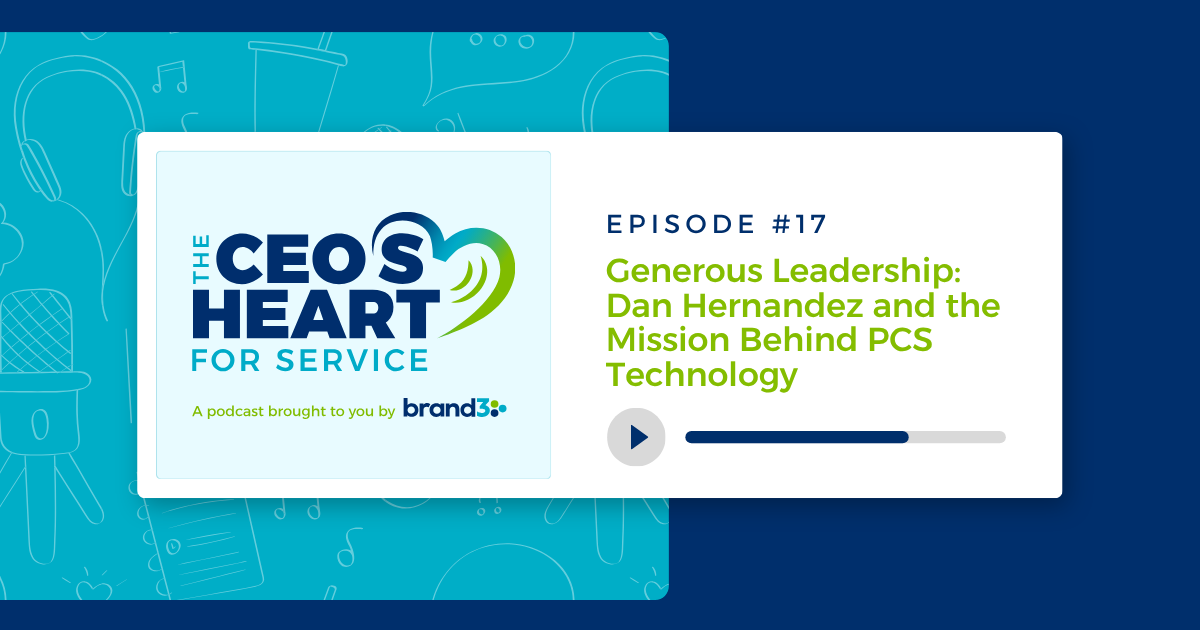
What happens when a technology leader treats generosity as a growth strategy, not just a nice idea?
Dan Hernandez has spent nearly four decades building PCS Technology into one of the San Francisco Bay Area's trusted IT and cybersecurity firms, with a particular passion for serving nonprofits. From his early days hustling paper routes and mowing lawns as a kid raised by a single mom, to building the first local area network for Bain & Company at the dawn of the personal computing era, Dan has always done things a little differently.
He shares information instead of hoarding it. He role-plays with his team before client meetings. He occasionally eats the cost of a ransomware cleanup because the client is a ten-year partner who had a rough year. And he once engineered a nearly one-million-dollar free Wi-Fi network for six thousand low-income housing residents using rooftop radio line-of-sight technology instead of expensive street-level fiber.
Dan talks about his journey from aspiring tennis pro to IT pioneer, the culture he's built around core values and raving fans, the real cybersecurity threats facing nonprofits today, and why he believes generosity isn't just good character, it's good business. He also opens up about the mentors who shaped him, the EOS operating system that transformed his company, and his audacious goal of serving over 100 nonprofits.
0:00 — Introduction
1:45 — Generosity and Nonprofit Joy
3:47 — Dan Joins the Show
4:48 — Early Hustles and Work Ethic
6:45 — Tennis to Computers
7:31 — Service Mindset in IT
8:55 — Founding PCS Technology
11:29 — What Makes PCS Unique
12:25 — Nonprofit Focus and Boardroom Insight
13:41 — Onboarding Roadmaps and Full Stack Services
16:02 — Books and Cyber Risk for Nonprofits
16:56 — Pro Bono Rescue and Real Incidents
17:59 — Hiring for Values and Culture Fit
19:42 — Creating Raving Fans
20:49 — Role Play and Service Standards
22:50 — Raving Fan Stories in Action
26:45 — Executive Liability Risks
27:59 — AI Driven Threat Surge
28:35 — Firewall Crisis Response
30:35 — Four Decades of IT Change
33:01 — Building a Scaling Team
33:39 — EOS and 90 Day Goals
34:46 — Core Values and Partnerships
37:02 — Mentors and Work Boundaries
39:34 — Giving Back and Mentoring
41:18 — Free WiFi for Housing
43:47 — Marketing Storytelling Shift
46:25 — Brand3 Messaging Results
48:41 — Behind the Brand Q&A
51:27 — Legacy and Contact Info
53:31 — Resources
There's a tension every leader of a B2B service has to navigate: How do you scale without compromising the quality of your services - or the values that drive them? The CEO's Heart for Service is where accomplished B2B leaders share hard-won insights on walking that tightrope.
The CEO’s Heart for Service is a production of Brand3. If you’re a B2B service provider who delivers exceptional service but struggles to get your marketing to connect with the right people, find us at brand3.net. And sign up for our Brand3 Newsletter that only sends marketing insights worthy of your inbox - genuinely helpful stuff for the road ahead.
The CEO’s Heart for Service is also supported by Forge Podcast Company, a turnkey production solution for using podcasts to reach a wider audience, win new clients, and grow. Find them at forgepodcast.co
Matt Wolfe, Brand3: Hi, everybody. Welcome back to The CEO's Heart for Service. I'm so glad you're here today. You're actually going to meet a Brand3 client today. We're talking to Dan Hernandez, who is the CEO of PCS Technology in San Francisco, and we really are always so honored to support Dan. We just really think the world of him, and you're about to find out why.
He's really the kind of client we always look for, someone who truly has a heart for service and works in what we would call a high-stakes, high-trust B2B service space. He's handling technology and cybersecurity, especially for nonprofits, and protecting them in every way possible so they can go forth and complete their mission, fulfill their mission, serve their communities, and make a difference in people's lives.
So that's who we get to talk to today. And Sarah, you actually have worked more directly with Dan. I'm especially curious if you had some surprises today along the way, things that you were like, "Oh, I didn't know that," or, "I'm so glad to hear this and know this about what he does."
Sarah Pattisall: I think the one thing that I've always recognized with Dan and being the CEO's Heart for Service, every CEO, we have one here, obviously has a heart for service, but there are so many different things that can go into that, right? The values that you establish for your organization, the culture that you create, how you treat those that you work with and those that you work for or you serve.
And Dan, it's like he knows every single element that it takes to be a CEO with a heart for service and goes above and beyond on all of those. And getting more details into the ways in which he does so today was just amazing for me to be able to hear. Because I always knew that, right? But hearing those concrete examples, it's really impressive.
Matt Wolfe, Brand3: It really is. He goes the extra mile for the people he serves, and the word that I've really taken away today is generosity. And it can be really hard to trust in and have faith that being a generous person is also a source of growth. You know, it can also move things forward and propel your own mission forward.
And I think you're going to find some encouragement. If that's the person you want to be, Dan's going to encourage you to be that. The only other thing I wanted to mention that I forgot to come back to as we were talking to him, but early on, he talks about how he thinks it's fun to support nonprofits.
And when you talk about nonprofits, you hear a lot about the struggles. You hear a lot about how hard it is, and I think it's this attitude he has of seeing it as fun and rewarding that is a big part of why he's succeeding. And that's something you're going to pick up on, too.
But how we tell the story of the work that we are doing for people, the way that we categorize that in our mind, also makes a big difference.
He's a big problem solver, and he's having fun doing it. And so, without further ado, we're going to give you the chance to hear directly from Dan Hernandez.
Matt Wolfe, Brand3: Hi, Dan. Welcome to the show. I'm so glad that you're here today with us.
Dan Hernandez: Thank you. I'm happy to be here.
Matt Wolfe, Brand3: I know we've been working with you for a while now. As I just mentioned before we hopped on, we're so proud to be telling your story and of the good work that you're doing down there in San Francisco. I can't wait to hear more about that.
There's a question that we like to launch in with because we do want to hear about the business, what you're doing, how it's grown, but we also know how important it is in the kind of B2B spaces that we're in for humans to meet humans. That's where real trust is built. That's where the connections are made that allow people to partner together and work together.
So the simple human question we like to kick off with is, when you were a kid running around doing whatever you were doing, what did you want to be when you grew up?
'Cause you probably didn't plan on starting PCS Technology.
Dan Hernandez: You know, I'm the ultimate entrepreneur, so I always had some ideas of some ways to earn money. I did a lot of side stuff. I was raised by a single mom, so we started working when we were young. We learned a strong work ethic and stuck to that, which is what got me to where I am.
Matt Wolfe, Brand3: That's fantastic. What were some of the side gigs? What were some of the entrepreneurial quests?
Dan Hernandez: The normal things, you know, mowing lawns, cleaning yards, paper routes, anything I could find.
Matt Wolfe, Brand3: I wondered if paper route would be in there. I did that too. I was a paper boy. I don't know if that even exists anymore, but it was such a great way for a young kid to learn responsibility.
Dan Hernandez: We had to collect that money, you know?
Matt Wolfe, Brand3: Right? There were no online portals when either one of us was doing that. You had to knock on someone's door and ask them for a check, give them a receipt.
Dan Hernandez: A lot of times it was cash, and you had to manage all that as a 12-year-old, 13-year-old. You learned a lot.
Matt Wolfe, Brand3: Managed some complaints along the way, you know? There was one guy I know who used to get on my case if that paper didn't land right on his porch, and I wasn't very athletic, so my aim wasn't that great. That's awesome to know that sort of thing was in you early on.
Was there a career path that you were hung up on? A lot of times people tell us they wanted to be athletes or astronauts.
Dan Hernandez: You know, I probably wanted to be a tennis player. I played tennis for fifty years, so that was early on. I had some injuries early on that delayed my development. I still played afterwards, but I didn't get into a D1 school to play.
But my junior year in high school was when I really got into computers.
My best friend was a genius, and the only thing I was better than him at was computers. So that was it. I was like, "This is what I'm gonna do." So I started learning all I could about computers.
Matt Wolfe, Brand3: That's awesome.
Sarah Pattisall: Now, I'm curious, through all of this, which we'll delve into more in the podcast, right?
Sarah Pattisall: You kind of live at this intersection of technology and service. So that passion for service and serving others, how did that play out into your childhood or young adulthood?
Dan Hernandez: We were always taught to be polite, be nice to others, and follow some really good core values. I was really good at what I was doing early on. At 19, 20 years old, I was already doing some consulting in IT, and it was just, you know, I had an approach that was a lot different than other IT professionals, where I shared information.
I empowered people, and that's been my approach my entire IT career, where a lot of people want to hold information close to the vest. You're not allowed to touch the file server. You're not allowed to do this, and I was the complete opposite of that. So I gained a lot of fans. I trained hundreds of IT professionals.
But then, on the other flip of the coin, we fell into the nonprofit world early on, about thirty years ago, and it was just something that was a lot more fun than working at the San Francisco Stock Exchange. It was more rewarding, and it felt better. So that's where I started going after nonprofits.
Sarah Pattisall: Go ahead and tell us some more about PCS Technology and what you all do and who you serve.
Dan Hernandez: Well, PCS Technology is... I started it in 1989. I was working for Bain & Company, which is a very large international management consulting firm. So I learned from some of the smartest business people in the world. And within three months, I was promoted to IT manager, so I had the privilege of having a big budget, able to bring in really strong technology, and I built a team, strong help desk, technical resources, training resources, and delivered a very high value of IT services to the clients of Bain.
The customers were the consultants of Bain & Company. I was the first administrative staff member that kind of started partnering with the consulting staff because I worked as hard as they did. So I was brought in and invited to do things that other admin were not invited to, and I kind of broke that, and then other admins were able to cross over as well.
So always a leader in doing what I did. And then I had this vision as I was looking around the streets of San Francisco and saying, "There's a computer in every one of these buildings on every floor, and they all need this support." And I felt that corporate support was not what I wanted to do long term.
I got bored. Once you fix everything, you know, you're just managing it. It's too simple. I always have to have a challenge. So I started Professional Computer Support, PCS, which is now PCS Technology. And I wanted to build a similar program that served people who didn't have access to corporate-level IT support.
So that is the foundation of PCS Technology that we even follow today. My senior staff has been with me twenty years, and they know what I expect and deliver that level of IT.
Matt Wolfe, Brand3: That's incredible. And what do the services look like? Managed services, many different forms for IT, so what does the service model kind of look like, just to help people understand that?
Dan Hernandez: Yeah.
Matt Wolfe, Brand3: Understand that?
Dan Hernandez: Well, we're unique, and I'll explain why. There's a lot of MSPs, a lot in the Bay Area. We have more experience, resources, and flexibility as I am the founder and CEO that other large MSPs don't have. I'm creative, I think out of the box, and I'll take on challenges that a lot of people just won't touch.
But more importantly, we built a culture here at PCS. People follow that mindset of serving the customers and simple rules. It's better to be five minutes early than 15 minutes late, and a lot of things that I've learned over my lifetime.
Matt Wolfe, Brand3: What are some... And then, as you mentioned earlier, to help people understand that too, then you found your passion for nonprofit, and that's the big focus now, of course, for PCS.
Dan Hernandez: We focus and market to nonprofits, but we've been in business thirty-seven years, so we have large general contractors, attorneys, CPAs, and a lot of different clients that we work with. The nonprofit world, we've grown. We currently support over forty-five nonprofits.
I've been serving nonprofits and working in the field, working with their technology, building their networks, upgrading things to get them to a level of support that they need to deliver their mission. And over the last thirty years, I've also served on nonprofit boards, been board president a couple times, and currently serve on the San Francisco Giants Community Fund.
I'm the board president of the Arc of the East Bay. So I know the ins and outs of how they work, how they budget, how they get funding, how they need to report back on their contracts. It kind of combines from the server room to the boardroom.
Dan Hernandez: And so, the other types of services we do is we're fully staffed.
We have a great team. We don't have issues finding people. People actually come to us looking for jobs, wanting to work for us. And that's because we're always growing, always learning, and we elevate staff so they know that as we grow, they're going to be elevated to a higher position, and they love that.
But we do, like I said, we're unique. We have a process in place where we do a thorough onboarding process where we document everything, meet with the client within thirty days to review their IT, figure out the important things that they need to fix, working within their budget. We don't go in and say, "Well, you gotta replace all these computers," or anything like that.
We say, "How can we get you there over time?" Sometimes with some nonprofits, it could take eighteen months as they need to budget and figure out how they could cover those costs. I put together a roadmap and plan to get them there.
Then on top of that, we have an excellent service manager, been with me ten years, that leads all the escalations for service.
We have two project managers that just get stuff done. So we could take on Zoom rooms, office moves, building out new offices and server migrations, email, cloud migrations, AI, and strategy. So we're a full one-stop shop.
Matt Wolfe, Brand3: That's fantastic. And I really appreciate your focus on the nonprofits, because I came to marketing by way of the arts, theater arts, performing arts, and have also been in administration in that world. So I got to experience the other side of that, the people who you're helping, and I know how hard it is.
I think, to my eye, no two nonprofits actually operate the same. They have unique cultures, unique team structures, unique job descriptions that stretch way beyond what everyone probably should be doing. There's just so much going on there.
Dan Hernandez: The first book I wrote was co-authored with one of my partners, Tim Keefe, and it's Cyber Liability Guard, which talks about all the different risks that are out there, what you need to do, what you need to be careful about. My next book's gonna be From the Server Room to the Boardroom, which shares all my in-depth experience from technology to the experience in helping nonprofits.
As board president, you know, you work closely with the executive director, so there's a lot of knowledge being put into this book around my 30-year career.
Matt Wolfe, Brand3: Wow. And there's so much at stake for them, too, that maybe not everyone understands. The relationship to the donors alone has to be protected in terms of cybersecurity, the lifeblood of what they do.
Dan Hernandez: We signed a nonprofit this year that's a small nonprofit with a limited budget. They were recommended to me by another nonprofit. Their mission is near and dear to me. So we took them on. We don't do this very often, but we gave them free support for this year and cleaned up their issues very quickly.
They had a hacker in their system, and they successfully redirected a very large donor payment. And it just... Man, when I hear those stories, it's heartbreaking. Once that money's gone, it's gone. And these smaller nonprofits can't afford to recover from that. So that's why I did what I did for them.
And we occasionally do pro bono jobs and projects for nonprofits at my discretion, because it's part of what we do.
Matt Wolfe, Brand3: That's wonderful.
Sarah Pattisall: You know, Dan, I've had the pleasure of getting to work alongside you in what we've been doing together at Brand3. And one of the things that's really stuck out to me as well is this heart for service that you carry through your daily work, and that has informed how you've built this company and your entire career, is also something that is so integral to your company culture and your team and the people you hire. And I feel like the culmination of all that is really quite magical in the level of service and support you offer because of that culture you've built.
Dan Hernandez: It's just not all me. I have a fantastic team behind me. My leadership team is Samantha Stoddard, who is my chief operating officer and my integrator. And then I have a director of service that has as much experience as I do, that we're very lucky to bring on about two years ago. And then we have Carlos Salguero, who's been with me 10 years as my service manager, who follows a process for interviewing, checking core values, and, depending on the role, making sure they have the skills to fulfill that role.
So when we hire, we usually hit the mark. It's very rare that someone starts with us and leaves within 30 days, which I hear stories about from other MSPs. So we have people that stick around, and that's important.
Sarah Pattisall: Well, and I think you hit the nail on the head as to why, right? You're doing that values alignment. You're ensuring that their values align with yours.
Dan Hernandez: Absolutely. And when Samantha feels there's not a core value fit, then they don't make it to the next level.
Matt Wolfe, Brand3: Dan, one of the things we like to talk about, we call this the CEO's Heart for Service, is just what that word service means to each of the people that we talk to. So, and you've given us some hints there already, but at the end of the day, what does it mean to you to deliver great service?
Dan Hernandez: We want to create raving fans. Every service call we create, every project meeting we do, every security meeting, every quarterly business review, we want to add value. So we come prepared, practice, we role-play. We don't just show up. A lot of that comes from my experience in sports, primarily tennis.
The things I've learned from sports, I implement into my life and into my business, and that makes us much more prepared. Technical staff know how to talk to clients, and everybody kind of learns when they're onboarded here at PCS.
Matt Wolfe, Brand3: Boy, the role-playing piece is so interesting to me. I think so many people are scared of that, don't want to do it. They'll make people mad when they say, "We're gonna role-play now." Otherwise, you've just got this huge mystery box of what people are saying when they're out with clients, and they're missing the opportunity to learn from each other.
I'm a StoryBrand certified guide, and I always say that Donald Miller created two things that are really powerful. One is the framework itself, but the other thing was this community of guides who would be in all these different rooms with all these different industries, road-testing this framework and how it works, and then we had this community to come back and talk about it and swap notes.
But I need to find a question in the middle of all that. I think my question is, how has the role-play worked for you? How have you made that work for you?
Dan Hernandez: Well, the first session with people is difficult. You know, as you said, people don't want to do it. They're embarrassed or shy, and we kind of break the ice with that, show by example. Even I role-play, even today when I take on a new program. We just started a new compliance program with CMMC, so we've been role-playing in how we're gonna deliver it, how I'm gonna talk about it, and we practice.
So that's very important.
I emphasize that a lot with my team. So that's really important. Creating raving fans is super important to us, so we go the extra mile. And I'll call people out. Is that really creating a raving fan? Let's get on site, let's do the right thing, and let's make them happy, even if it's gonna cost us something.
I don't care.
Matt Wolfe, Brand3: Yeah.
Sarah Pattisall: Can you give us an example, and you don't have to name any client names or anything, of one of those moments where you've created a raving fan and kind of walk through what led to that happening?
Dan Hernandez: Well, we did a very large project for a nonprofit that's about 120 staff members, and it was difficult moving them from on-premise file servers to Google Workspace. I would prefer personally to move them to Office 365, but they were already a Google client and had experience with that. So we don't force people to take recommendations.
We just roll with it. We're very efficient in both platforms. But what we missed was the last part of the project because, when you remove a file server, every device in the organization is talking to that file server, and it's attached to that domain. When we want to decommission those file servers and get them out of the environment, we have to reset up every computer, and we missed that, and it's probably a ten-thousand-dollar step.
And so I was not gonna go back to them and say, you know, "We gotta charge you for this," or anything like that. So I just did it. We just took on the project and just delivered it.
Another one was we had a long-term client that was struggling, and they were not able to take my recommendations on upgrading their firewall, which was pretty bad. Hackers can find vulnerabilities faster than ever. And so with that weak firewall, they were able to get into the environment and ransom the entire organization of about fifteen staff members.
And due to the economy and what was going on in the world, they were struggling financially, and they've been a client of mine for ten years. So I was in the game with them, and we could have charged them. It cost about fifteen thousand dollars to clean up that event. And because we're in the game with them, they've been a long-term standing client.
I had a strong relationship with the owner. I did all the work at no cost. So we just stepped in and helped them because it was serious. They needed to get back online. The good news is, because of our support, we didn't lose any data, did not have to pay the ransom. We were able to recover everything, but they were a very high-end architect firm, so we had to reload every one of their computers, which takes a lot longer than the normal computer.
And we had to rebuild their file servers and get them back online, and it took a lot of labor. So I just ate that labor and got them back in business.
Sarah Pattisall: And I'm sure that they are gonna be your client forever, as long as they are in business.
Dan Hernandez: You know, it's just, I make these decisions.
Sarah Pattisall: That's a testament to—
Dan Hernandez: On my own. It's at my discretion, and I want to do what's right.
Matt Wolfe, Brand3: Phenomenal. You know, most nonprofits are one incident like that away from oblivion. I mean, unless they really have deep roots. So to have someone who steps in and understands that, with that level of empathy and understanding of their situation, is really powerful.
Dan Hernandez: Well, this is why I meet with all the clients and explain these risks because I cannot always eat the cost of cleaning these messes up. I work really hard to try to ensure that our clients are not gonna have an incident, which we're very good at.
Dan Hernandez: And that's why I want to write this book, because part of it is explaining to executive directors that this is their responsibility, not their staff, not their MSP, and not their internal IT guy.
If they have an incident, they're the one that's gonna be sued. They're the one that the attorneys are gonna go after, and people that have spillover if their clients get hacked or some of their partners get hacked. There are now attorneys that are chasing these events like they chase ambulances because they can make a lot of money doing this.
So executive directors and CEOs don't understand that risk. And if they have cybersecurity insurance, they're not gonna pay the claim if you're not doing what you said you're gonna do. So when you fill out that application and you did not fill it out honestly, they will verify it when you have a claim. They're not gonna pay the claim.
So we make sure we show evidence that we're doing what we say we're doing and make sure that we cover all those bases.
Sarah Pattisall: I was assuming earlier when you mentioned how in 2025 hackers got a lot more aggressive and better at this, that was due to advances in AI.
Dan Hernandez: Absolutely. We're using AI to scam the world.
Sarah Pattisall: Then I can see how the hackers using AI, and I know after a breach, right, they have to worry about the documentation, how that would just rile up all of the people involved to be even more, I don't know the word I'm looking for, like on top of everything than ever.
And in return, the nonprofits must be really cognizant of their systems and what's happening.
Dan Hernandez: At the end of 2024, early 2025, we had about fifteen clients on a brand of firewall that was no longer safe. So we did a huge campaign to reach out and get them on a better firewall. I was traveling for work at a peer group meeting where I was in a Black Uber with probably five CEOs at MSPs across the country.
When it really got serious and hackers were knocking down everybody that had that firewall in place, luckily, I only had one left. They were calling their staff at eleven o'clock at night, midnight, depending on what time zone they were in, waking them up and having to shut down every one of their clients that were on that firewall to prevent them from getting ransomwared.
I called one client and told them, "We're shutting down your remote access until morning. This is serious." And the client was, "Thank you." You know, very appreciative that we're on top of it. But if I had those other fifteen clients on it, it would've been a bigger event for us. We try to stay ahead of that stuff.
Matt Wolfe, Brand3: The change that you must have seen over the years starting in 1989 is phenomenal. That really places you, from my understanding, as a pioneer, as an early leader in the very idea of managed services provider and IT provider.
So, the big theme of this that we like to explore in this podcast is if someone like you, who we clearly understand now has a real heart for service for the people who they care for, then as you grow, there's always gonna be this question: How do we keep delivering great service to people?
How do we expand this team and maintain the quality of what we do and the core values that drive us? So I'm curious where you have seen challenges. Where have been the big lessons, the bumps in the road along the way to do that?
Dan Hernandez: Well, when I started my business, there was no internet, no email. Things have changed drastically. I fought my first computer virus at Bain & Company in 1989, and it was spread by floppy disks, and it was serious.
So I've seen it all. I started out with the original PC, original Macs, so I've seen it all.
I built the first local area network for Bain & Company. I had an internal email system for three thousand employees worldwide that we used with a 286 and a 2,400-baud modem, and it worked fantastic. So I did a lot of things early on that were cutting edge.
Matt Wolfe, Brand3: Yeah.
Dan Hernandez: Then I've redesigned the company probably four or five times, from doing a lot of break-fix, from LaserJet repair and a lot of different things we did early on to more consulting, more network support, managed services.
And, you know, since probably in the last six years, we got very heavy in compliance, HIPAA compliance, GDPR. We're starting now with SOC 2, things like that, so we can handle all that. We dove into AI about two years ago, so we're way ahead of the curve than most MSPs. So the reason why I still do this after forty years is it's constantly learning.
I'm always challenged to learn, and I travel the country at least four times a year. I attend a lot of the really strong IT events. I weeded out the ones, and I learn from the industry's top people in different fields. I bring that knowledge back, and my integrator, Samantha, and my service director implement my ideas.
So I'll lead the charge like CMMC. I probably spent six weeks on my own figuring it all out, and then once I figure it all out, I turn it over to Brody, and Brody takes it and runs with it, and I'm out of it. I just have to sell it.
Dan Hernandez: That was a game changer, having a really good team behind me, where back in the day, I was doing it all on my own.
Matt Wolfe, Brand3: Were there moments along the way that really stood out to you where you realized to scale this company, we are really gonna have to transform in a certain way, or we're gonna have to change in a certain way?
Dan Hernandez: I've been growing the company steadily. And so there are milestones in our industry, and then once we got to the milestones, it was like, okay, we really gotta change how we work.
Dan Hernandez: And so we implemented EOS, which is the Entrepreneur's Operating System. And so we invested a lot of money into the organization and worked on the business. That was a huge game changer.
So I literally live my life in ninety days. Not only the business, but also my personal life. I'm a goal setter. I start setting goals early for 2027. I'll start this month, and start figuring out security platforms, AI platforms, financial goals, sales goals, et cetera. And so I meet my goals. And I do the same thing in my life.
I had both my knees replaced last year, so my goal is to travel to Seattle and beat my brother in tennis. I'm so close to being able to travel to Seattle and play my brother.
Sarah Pattisall: I did not know that.
Dan Hernandez: You know, I'm gonna make that happen because before my knee surgeries, I was able to beat everybody, so I gotta get back.
Sarah Pattisall: I got a kind of follow-up question to Matt's there. I know how important the core values are to your organization. I'm curious if you can talk a bit about how those may have been created or changed over time out of necessity as your business has grown?
Dan Hernandez: I can't talk too much on it. I really rely on Samantha, kind of the integrator that leads that conversation. But we're really lucky. In our business, we create partnerships, so I've been able to create very strong partnerships with several CEOs of large vendors of ours, where I have a personal relationship. I've created resources that we have access to that other MSPs never have.
And, you know, I surround myself around smart people, and over the years, working with Samantha by my side, we've learned from some of the smartest people in the industry, and that's how we have adjusted a few things. And then Samantha will put her spin on it. I give her full rights to lead that, and I stay in my lane.
Matt Wolfe, Brand3: Did you play singles or doubles in tennis?
Dan Hernandez: I played both.
Matt Wolfe, Brand3: I guess they call—
Dan Hernandez: I was a master doubles player. I started playing tennis, it was all the John McEnroe era, so we were all serve-and-volleyers, which makes a really good doubles player. But in my earlier days, I played a lot of singles.
Matt Wolfe, Brand3: The reason I ask is I think you seem to have a really keen sense of how important your team is and how much you need the people around you. I just read a great column in The New York Times over the weekend that singled out a particular reason why people succeed in business and in life as being the people who realize they can't do it on their own and shouldn't have to do it on their own.
Dan Hernandez: I learned that from my Bain days. You know, the president of Bain & Company came out of the San Francisco office. The first president worldwide was Tom Tierney in San Francisco. And in those days, I had built the first local area network, and there were days when I came in at five in the morning to restart things and Tom would be there.
He would wave to me. I had a line of sight to his office, telling me the coffee was ready. And I would tell him, "All right, I need fifteen minutes. I'm gonna restart everything." He goes, "That's fine. I'll do some other things." And I built a strong relationship with him. I was working as hard as the consultants, and that was a first.
And I learned that during the holidays, you never work during holidays. You give your... So a strong rule for us is we don't work four-day weekends. We do not work Christmas, New Year's Eve. It's a strong no. And we get asked all the time, and it's like, "No, we will not work the day after Thanksgiving."
It's... there's no way. And then other things like that I've learned from the second president of Bain & Company, John Donahoe, who went on to be the CEO of eBay, and I think he's the CEO of Nike right now. And he taught me to surround myself with very smart people. I have a therapist, I have a business coach, I have CEO buddies that are my accountability partners.
I have a lifelong friend that's a tennis pro. I call him Coach. He's my best friend in the world, and we travel together and hang out, and he's another mentor of mine. So I'm really lucky to have him because as I'm getting back on the tennis court, he's there to correct my little things that need correcting.
So I surround myself with very smart people, and I learned that in my Bain days.
Sarah Pattisall: Something I think that's worth remarking on here, Dan, is, you know, you're talking about all these brilliant people you surround yourself with to learn from, and I know that you're taking everything you learn and you're freely sharing it, like, in your own life as well and giving back, and it's like you're creating this cycle of learning and giving that I think is really powerful and is why PCS as a whole is so great at what you all do in serving others.
Dan Hernandez: Absolutely.
Dan Hernandez: And I have MSP partners across the country that reach out to me. Just recently, I got a call from a really, really strong salesperson for a very large MSP, and they lost a forty-thousand-dollar-a-month client, and it hit him hard. And it was a mistake that service made, so it hit him even harder.
And so I was able to pull some really good quotes for people I follow and kind of turn his day around. So I love doing things like that, being that positive reinforcement. And we set some goals together between now and the end of the year that we will both hit. We'll hold each other accountable to that.
And he changed his attitude. He was pretty down when I talked to him. I also speak to a group of students from Dev Mission on a quarterly basis. They bring their new cohorts into my office. I share my life story. And I've been able to do some motivational speaking for football camps and other things from friends that invite me to do those things.
So I love sharing my knowledge with others.
Matt Wolfe, Brand3: Well, that's wonderful.
Sarah Pattisall: I want to say quickly too, something we haven't discussed yet that I just know from working with you, Dan. One thing that I really respect about PCS is, you serve nonprofits. Many of your team members are involved in the nonprofit world in various ways, but then your company actually has internal initiatives, right? I don't know if you want to speak any more to that, for instance, the Wi-Fi one.
Dan Hernandez: Gosh, probably about 15 years ago, I was challenged to build a free Wi-Fi environment for a very large low-income housing provider. There was a grant available from the California Public Utility Commission, and I was able to receive the grant for nine hundred thousand dollars and build out the free Wi-Fi in 15 of their buildings and implement the solution and fulfill the grant, all the requirements, and deliver them almost a million dollars worth of free Wi-Fi.
Based on that knowledge, we have now provided free Wi-Fi for about six thousand low-income housing residents across San Francisco. And so I took a different approach. I worked on this for several months, and finally a light bulb went off, and instead of doing the traditional wiring through fiber in the city streets and digging up things that's super expensive, could be fifty thousand dollars to pull cabling to a building, I threw radios on the rooftop and created a line-of-sight network and expanded the network with Wi-Fi radios.
And we have that working today, and it was a big achievement that I'm really proud of.
Matt Wolfe, Brand3: Wow.
Sarah Pattisall: It could be wonderful.
Matt Wolfe, Brand3: That's a great example of the creativity and the out-of-the-box thinking that you were talking about earlier. I wrote down the word and circled it and put a box around it even: generosity. I think it's one of the things I'm taking away from this conversation, the power of generosity in a lot of ways.
Whether it's through our business or individually, we sometimes forget or lose confidence in the idea that just doing the right thing can really end up being profitable, driving growth as an outcome, in the best possible way.
Sarah Pattisall: And you can measure value in so many ways.
Dan Hernandez: It's really served us, and it's a value my entire team follows. So I think it's very valuable for organizations to have that mindset.
Matt Wolfe, Brand3: We talk a lot. I want to pivot just briefly to your identity as this generous service provider within the nonprofit space. We work a lot with B2B service providers who have given up on marketing because it just hasn't worked for them in the past.
And usually the first thing that sort of went haywire, that didn't work right, is they were needing to tell the right story to the right people.
That's how I describe brand strategy. At the end of the day, it's about making sure you're sharing the right message with the right ideal client, the right target audience. And usually we like to ask people what their experience has been in that space, and we're cheating a little bit because you've been through it with us recently.
But I'm curious, what was the exercise like for you? What did you take away from your recent work with us, of dialing in your messaging?
Dan Hernandez: All right.
Matt Wolfe, Brand3: And—
Dan Hernandez: So it's a long story. I'll keep it short. I dove into sales and marketing when I met Robin Robins and her community called the Technology Marketing Toolkit out of Nashville, Tennessee.
Matt Wolfe, Brand3: Oh.
Dan Hernandez: I attended one of her conferences in Los Angeles and signed up right away. Traveled to Nashville, and I signed up for what they call the Producers Club.
And so I went to Nashville four times a year. She provided an excellent program where she brought in many really strong speakers that I still follow today, Jesse Itzler, Jack Daly, and many others. Buzz Aldrin was amazing. You know, he was the second person to step on the moon. And so that got me started at really thinking about marketing. My accountability grew really.
You know, we tried a lot of different things, bulky mailers, cold calling, having a dialer, dialing for dollars. It just doesn't work in the Bay Area. I learned that early. And I worked with several different marketing organizations over the years, and I ran into Orsi at an EOS Worldwide event, and we connected immediately, and we were going toe-to-toe on, "You should do this. You should do that."
And I think Samantha and people from Brand3 were going, "How long is this gonna go on?" And Brand3 people are going, "Well, Orsi is not gonna back down." And Samantha's going, "Well, Dan's not gonna back down." And it was a fun, great conversation.
Dan Hernandez: Samantha retained a connection to Brand3. We really needed to shift our marketing, and we interviewed four different firms, three just prior to Brand3, and the minute we started talking with Brand3, I let the other three know, "Don't even bother sending a proposal."
We already picked our company. I would just... Orsi and I just connect. We have very similar mindsets. Then I met Sarah and everybody else, and it's been fantastic.
So the quality of product is top-notch. The work that they put in, first and foremost, to learn about PCS Technology, create that marketing document.
When I make a request for a presentation, it's ninety-nine percent correct. The only edits I ever have to do are to change some things about how I speak, because when I'm on stage, I want it to sound like me. But it's so on target. Everything is almost perfect every time, and that is unheard of in this space.
Other experiences, I would have to go back and forth. They wouldn't deliver on time. I would have to get on calls with them over and over to do edits, and it was just really frustrating. I have none of that with Brand3.
Matt Wolfe, Brand3: Oh, that's wonderful. And of course, a big part of the journey there was dialing into your nonprofit audience and making it really clear. I refer to you when I've... I do talk about your company a lot because of the work we've done there. I refer to you as the champion of nonprofits in San Francisco, because that's really who you are. So we just had to tell that story. I'm glad you've had that experience with our team.
Sarah Pattisall: Me too.
I have to say, Dan, to give you a bit of an internal perspective quickly, you all make it easy for us to deliver excellent work because of who you are. So thank you.
Dan Hernandez: Thank you.
Matt Wolfe, Brand3: Well, we're about out of time. We've got a last thing we like to do because, again, when we talk about these sorts of B2B services like you offer, nothing's gonna move until a human meets a human and gets a sense of, "I wanna work with that person."
So we've got a behind-the-brand questionnaire we like to walk through so people can get to know you a little better, and if you're game, we're gonna run through a series of seven questions real quick with you.
Dan Hernandez: Sure.
Sarah Pattisall: I'm gonna kick it off here.
Sarah Pattisall: Question: What is your go-to karaoke song?
Dan Hernandez: Why don't we say Tom Petty, "Learning to Fly"?
Matt Wolfe, Brand3: Nice.
Sarah Pattisall: Petty poster behind you, and I was wondering if you're into Tom Petty.
Matt Wolfe, Brand3: That's our first Tom Petty reference. That's excellent. What is the last thing that made you laugh out loud?
Dan Hernandez: When we were doing a photo shoot yesterday, and I was having a hard time smiling, and my executive assistant, Tammy, was doing this little dance behind the photographer.
Sarah Pattisall: Great. What is your favorite way to get away from it all?
Dan Hernandez: Go to Hawaii and work from Hawaii. I'm an early morning person, so I get up at 4:30 in the morning. I work a few hours. I have really good visionary time. I love to swim in the ocean. I love to walk, ride bikes, and work out. So I'm just in my element.
I try to go at least three times a year. And the last time I was there, I worked the whole week.
But, you know, you're in Hawaii, and you get done around two o'clock, and then you're in Hawaii, and you could go play.
Sarah Pattisall: Sounds awesome.
Matt Wolfe, Brand3: Okay, you've completely changed my plan for future productivity and working retreats, because that sounds amazing. Okay, next question. What smell reminds you of a specific place or time?
Dan Hernandez: The ocean. I love walking on the beach. I go to Fort Funston, which has gorgeous trails, horse trails, and you could walk on the beach. And I grew up in Watsonville, California, and spent a lot of time in Monterey Bay, and that's my happy place, the ocean.
Matt Wolfe, Brand3: That's wonderful.
Sarah Pattisall: What is one day in your life that you would like to relive?
Dan Hernandez: I guess I'd have to say meeting Samantha.
Matt Wolfe, Brand3: What are three words that your loved ones would use to describe you?
Dan Hernandez: I'm their rock. I'm their reliable source. I'm always there for them.
Matt Wolfe, Brand3: That's awesome.
Sarah Pattisall: All right, last question.
Sarah Pattisall: What would it mean to have truly succeeded in your work, and not your company, but for you?
Dan Hernandez: Leave a legacy for my children and family. I love traveling, and I love having the resources to bring my friends with me that may not have the resources I have. And be able to... My big, hairy goal is to support over 100 nonprofits and be able to just be known as that guy that worked with the Giants and The Arc and Tel Hi and served the community.
Matt Wolfe, Brand3: That's great. Dan, it's been a joy to spend this time with you. I really appreciate you spending it with us. I do think we've... you've said a lot of things that can just really encourage other people on their journey to be true to themselves, true to, you know, to unleash a generous spirit if that's stirring within them.
Just so many things, and I'm just grateful. I think anyone would be crazy not to work with you, especially if they're a nonprofit, not to pursue you and talk to you. What's the best way to reach out to you at PCS Technology?
Dan Hernandez: Well, our website is pcstechnology.com, and my email is [email protected]. I reply to all my emails, and I'm happy to have a conversation with anybody, even if it's just to educate them about their choices. You know, I've had conversations with people where we're not a good fit, and I have resources that may be a better fit.
So I'm willing to talk to anybody that has a cybersecurity incident and help them at no cost, because I want to serve a million people and protect them from cybercrime.
Matt Wolfe, Brand3: Wow. Well, there's one more, one last demonstration of your generosity and your care for others. That's a good way to wrap things up.
Matt Wolfe, Brand3: From our side of things, Brand3 specializes in B2B services like finance, tech, B2B consultants, anything that is high-stakes, high-trust. And if you are in that category and you have struggled with marketing in the past, we have a program for you called Scale Beyond Referrals.
You can get to know us through an introductory workshop and learn more about that at scalebeyondreferrals.com. Other than that, my name is Matt Wolfe, and this was Sarah Pattisall here with Dan Hernandez, and we will see you next time on The CEO's Heart for Service. Thank you.



MAILING
201 Market Street S
Suite 201
Havre de Grace, MD 21078
OFFICE LOCATIONS
Havre de Grace, MD
Lake Stevens, WA