

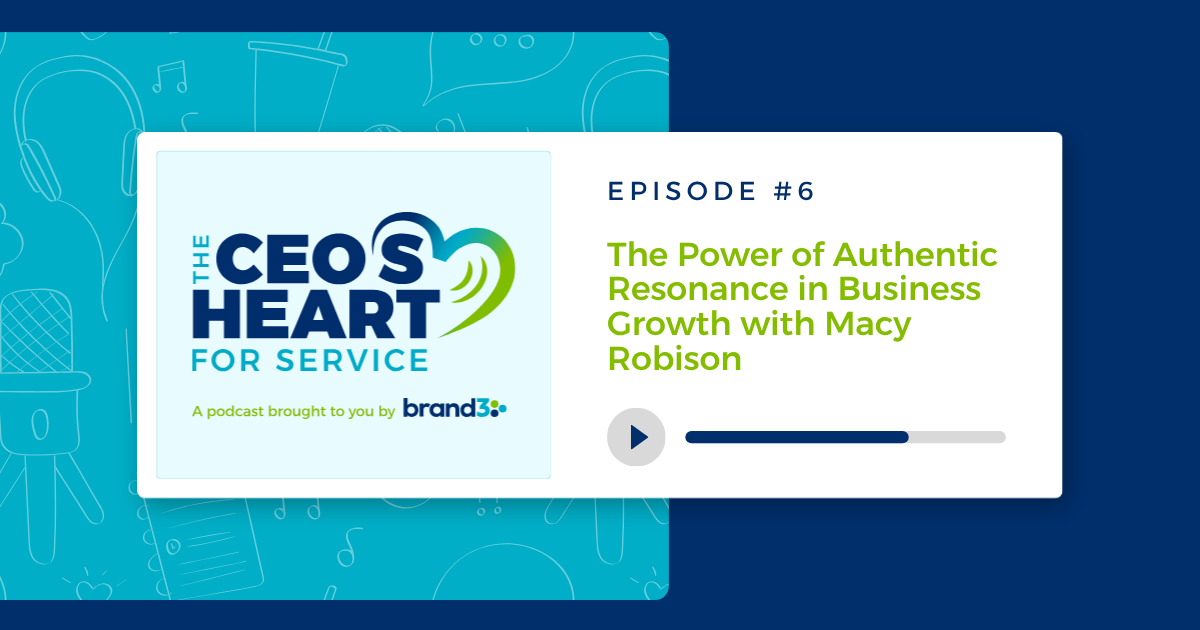
What if the reason your thought leadership isn't landing has nothing to do with your ideas, but everything to do with the way you're wired to share them?
Macy Robison, founder of the Resonant Thought Leader Conservatory, has spent years behind the scenes launching New York Times bestsellers, building massive platforms for other thought leaders, and serving as senior director of StoryBrand's certification program. But somewhere along the way, she kept hitting the same wall. Brilliant experts were not stuck because they lacked ideas, but because they were forcing themselves through someone else's playbook.
What she built to solve that problem is unlike anything else out there. Rooted in the science of sound and resonance, her proprietary Resonance Compass framework starts with a free diagnostic, the Resonant Thought Leader Archetype Assessment, to pinpoint exactly how you are wired to communicate, lead, and build. From there, it becomes about amplification, not volume. About sending a clearer signal, not shouting louder.
We talk about the journey of creating a brand new framework from scratch, the challenge of scaling something deeply personal, and how she stays grounded in her own voice even when comparison tries to throw her off. If you're a B2B founder who knows you have something valuable to say but can't figure out how to say it in a way that sounds like you, this conversation is for you.
There's a tension every leader of a B2B service has to navigate: How do you scale without compromising the quality of your services - or the values that drive them? The CEO's Heart for Service is where accomplished B2B leaders share hard-won insights on walking that tightrope.
Matt Wolfe: Hi, everybody. Welcome back to The CEO's Heart for Service. This is, as they say, a very special episode of, of our program. I'm here with Tav Laskauskas, our brilliant director of marketing services at Brand3. Hi, Tav.
Tav Laskauskas: Hey, Matt.
Matt Wolfe: Tav, we just got done talking to Macy Robison, who is the founder of the Resonant Thought Leader Conservatory, also the host of the Own Your Own Impact podcast, and just an all-around amazing human who has created a way for business leaders to feel free to be more human, I would say, in their thought leadership, in their communication with the world. Tav, what did you take away from this conversation today? What do people have to look forward to?
Tav Laskauskas: Authenticity and the value of it, I think it sometimes can get lost, especially in our industry with so much talk about AI and new tech and all of these things that sort of take the h- humans out of interaction with different brands and with businesses.
And for Macy's approach to really focus on the human element of thought leaders and not just their knowledge and their expertise and those kind of, you know, looks good on paper pieces, but the messy parts of them that make them authentic and relatable and someone that you can connect with. I think the way that she's found to tap into these things that maybe o- other people have tried to train out of themselves, to their detriment, and that she views them not as differences to be avoided, but unique qualities that bring strength and value, I think is really powerful.
Matt Wolfe: I would say she's also just helping people answer the first sort of panicky question that comes up when people ask you to be a thought leader. It's like, "What am I gonna talk about?" And it- Yes ... you know, what ... Do I have enough to talk about? Do I have something? But what we're telling leaders of B2B services all the time is they, in helping them see, helping them uncover, is that they do have a unique perspective on their industry.
I have yet to meet someone who doesn't. I don't care how boring or mundane or routine they think what they do is, 'cause a lot of people judge themselves that way, especially in, like, sectors like finance and tech, but they have something, and they've been figuring it out and, and developing it throughout their whole career. And that comes up today, too. Like, you have so much more in the tank than you realize, and, and Macy's service is a great way to help unlock that. So we'll go learn more about that. We're gonna head on over to our really fun conversation with Macy Robison. Hi, Macy.
Macy Robison: How are you, Matt? Good to see you.
Matt Wolfe: I am so good.
Macy, we met, of course, through the StoryBrand community, which you are still a part of. I go pretty far back, but you're one of the, the OG original StoryBrand people. But what stands out to me as I think about having gotten to know you is, uh, I hope you know how much you are really just respected and loved by that community for all of the heart and care and concern that you have poured into it over the years.
Macy Robison: Well, thank you.
Matt Wolfe: You're welcome. And we connected of course because we are theater people.
Macy Robison: That's right.
Matt Wolfe: People of the stage, storytellers.
Macy Robison: People of the stage.
Matt Wolfe: And Tav shares that too. Tav has been involved in dance and- Awesome. Tav, your latest side gig was directing how many kids in a musical?
Tav Laskauskas: 30. 30.
Macy Robison: Outstanding.
Tav Laskauskas: Yes.
Matt Wolfe: 30, yeah.
Tav Laskauskas: And the average age that I'm working with is nine, so I've got littles as young as four.
Macy Robison: Oh, wow. What show?
Tav Laskauskas: We are doing selections from The Greatest Showman.
Macy Robison: Perfect.
Tav Laskauskas: Yeah.
Matt Wolfe: Amazing. tab later we'll talk about how I wrangled 60 kids in a children's theater production. Those are the things we do when we live in that world. But here we are. So our usual thing, our usual thing of course, is to talk about a core challenge that faces any service-based business as they grow. How do you continue to maintain the quality of the service that you offer and stay true to your core values along the way? In other words, how do you, how do you hold true to what made you powerful and unique and special to begin with as you grow, if you're someone who cares about the people who you serve?
What's fun today is what we're gonna talk about is your business, your current business is fairly new. You've been on a long journey to get there. So we will talk about the challenges of, of scaling and growing a very unique service that you've created. I think you've also created something that is going to unlock for a lot of B2B business leaders something that they've been feeling, they don't know is holding them back. They haven't been able to name this thing yet, and it's gonna be a powerful tool for scaling and growth.
Macy Robison: Love it.
Matt Wolfe: Today I have a, a wonderfully written bio for you, which I would love to read 'cause I think it gives us a nice baseline for where you're at. So with your permission, Macy, I would like to read your story.
Macy Robison: I would love that.
Matt Wolfe: All right. I love this. Macy Robinson helps experts become impossible to ignore. If that doesn't have your attention, I don't know what will. Not by getting louder, but by getting clearer. After years of building massive platforms for other thought leaders and helping launch multiple New York Times bestsellers, and spending time as senior director of StoryBrand's certification program, Macy kept seeing the same pattern.
Brilliant experts who were stuck, not because they lacked ideas, but because they were trying to express them through someone else's playbook. That pattern, and her own struggle to articulate her expertise after years of making other peoples visible, became the foundation for the Resonance Compass, a proprietary diagnostic framework built on a simple but radical premise: resonance is measurable, not subjective.
At the center of the system is the Resonant Thought Leader Archetype Assessment, a free diagnostic with more than 900 completions that identifies exactly how an expert is wired to communicate, lead, and build. So through the Resonant Thought Leader Conservatory, Macy works with established thought leaders, experts, and founders to translate their wiring into a platform, an offer, and a body of work that finally sounds like them A speaker and performer herself, Macy lives in Utah with her husband, two teenagers, a devoted Aussie doodle, and a Dr. Pepper Zero with coconut and cream habit her family has stopped trying to understand.
Macy Robison: They just support it. They don't understand it. They just bring me soda. That's right. It works out great.
Matt Wolfe: And we can't help you with that today either.
Macy Robison: It's okay.
Matt Wolfe: We're here to support you. So Tav, you're hearing this all for the first time. What do you think?
Tav Laskauskas: I think this sounds amazing. Where do I sign up?
Macy Robison: Perfect. That was the easiest pitch ever. I'm just gonna have Matt follow me around and read my bio. Yeah. Wonderful.
Tav Laskauskas: It's great.
Matt Wolfe: Macy, what was the aha moment? So we're getting a sense, you know, of what this is and, and why it was needed thanks to that bio, but what was it that just sparked for you, okay, the world needs this thing?
Macy Robison: I think we always create the thing that we need ourselves, and I've been, you know, like you said, behind the scenes in a lot of different thought leader businesses, helping them build platforms and sell books and create podcasts and, and do so many different things to put their work and their voice out into the world. And I knew I was learning a lot about how to do that. I knew people wanted to learn what I knew, and I was having an awful time doing the thing that I was an expert at helping other people do for myself. And so I tried to buy expertise and certify in things and, and figure out, like, if this person has the answer, surely I can go take this course or borrow that strategy and copy and paste it onto myself, and I will magically get the same results.
And I basically just kept getting frustrated again and again. I was able to still help people. Like, just as an example, I was a strategist inside of a personal branding firm that is wonderful. Like, wonderful people at the center of it, really great frameworks, very strong reputation. I was one of their first stra- strategists they brought in, was still, you know, doing StoryBrand work at the time as well. I hired a fellow strategist to help run the system on me because I couldn't do it from the inside and still couldn't land on, you know, messaging or any kind of one-liner or, or framework that really felt like it belonged to me. And I realized a lot of that came from two things. One, I was getting frustrated 'cause I was copying and pasting other people's path instead of trying to start from who I was and grow from there.
And then the second thing that I feel like was finally an aha moment was in the bio you said, "I'm a performer." We both have done theater. We've all been on stage. I have a really deep background in singing, and I truly believe everybody can learn how to sing if they have vocal cords and lungs- Yes ... and most of us do. Doesn't mean they're gonna be on Broadway. It doesn't mean they're gonna be on American Idol or at The Met, but they can create a sound that is pleasant to listen to. And I deeply believe everyone who is the face of their business, regardless of what they're offering, can create an impact, and sometimes to get people's attention, your, your work is impactful. The thing that you're doing, the service that you're providing does make a difference. It solves a problem. It creates an impact. And making that impact on your terms has a lot to do, I think, with the path of a musician. And so it was kind of putting all of those things together and realizing the difference isn't volume.
We can't go out here and shout against all the ads and content and things that are out in the world, but what we can do is focus in on the signal that is exactly ours to send- Which has to do with resonance, and resonance in a sound wave is measurable. We can actually take any vibration and measure it. And it all came together when I remembered a lesson I used to teach when I was teaching junior high. I've worked with a lot of youngsters in music as well. Was teaching junior high, and my favorite thing to basically illustrate the way resonance worked was pushing a key on my piano, and a snare drum would vibrate on the other side of the room.
And when I pushed other keys, that didn't happen. When I played louder, nothing happened. It was that specific key and that specific snare, and that was an illustration of resonant frequency, that every object has a vibrational frequency that can be measured. And when something meets that and it's tuned to the same wavelength, which is something we say when we hear something that's true, that resonates with me.
"Oh, we're on the same wavelength. Oh, we're vibing." We use music words to describe that experience. And kind of putting all that together, realized, wow, if we can figure out what are the steps that we need to take to communicate in a way that the signal is ours and it's clear, the people who are meant to work with us, who we are meant to reach, will vibrate with us and move with us just as effortlessly as that snare drum did when I pushed that piano key. And I don't have to work harder, and I don't have to dance on TikTok, and I don't have to do things that I don't want to do in order to get my message and my work out in the world.
Matt Wolfe: That's why I'm so excited to talk about this is, as brand strategists, we're also trying to find that same vibe between-
Macy Robison: Right
Matt Wolfe: the business and its ideal client. Like, who's really gonna respond to your message? Who are you going to vibe with- Mm-hmm ... as you work together and get the best results? Right. And man, if you can lock into that, you've really got a ballgame. And at the same time, almost all of our clients are B2B founders, right, who need to be the voice of their business, and we are on a constant quest right now to help them be less digital and more human in their marketing, to create more person-to-person human interactions so that they can create that, that, that vibration with people.
You're the only person I know talking a- about this out there, which I think is incredible. And I've had my own experience with it that I'll talk about in a second, but I... Why wasn't anyone doing this yet? Why were we missing this?
Macy Robison: That's a great question. I think part of it is it's very specific to my unique experience. Sometimes I apologize in advance for how much I'm about to talk about music and the science of sound and- ... and things like that. But I, I think, like I said, the, the experience that we have, the unique walk that we've taken to solve problems, to figure out a solution, you know, great B2B businesses really are about solving problems for people, and figuring out what is the connection between this real pain point that someone has and the service or the software or the, the thing that I can provide to solve that problem.
And when we can match those two, all of us, I think, you know, in StoryBrand l- language, we're best when we can show up as the guide and let our customers be the hero. But in order to be a guide, we really do have to walk a hero's journey path, and if we can look at the lessons that we've learned and the things that we know and let that color the way we talk about things, the way we teach about things, and do it unapologetically, I think it makes the thing we teach the most human.
Like I said before, it really has come from me trying to solve my own problem. I've done a lot of great brand work as a partner with a thought leader, as a customer myself. I think that from a visual standpoint, from an experience standpoint, from, like, creating what a brand experience is, like- It's such a wonderful process, and I am terrible at answering questions about myself. Um, when someone has to come with me and, and make me answer a bunch of questions about what I'm great at or what I care about or what I want to do, I don't necessarily do well answering those questions. But if I've got something to respond to, like an assessment, I'm able to really dig in and give better answers.
And I think part of it is, what makes it different, is that it's rooted in my experience and how I see the world. And I was just seeing patterns everywhere for how sound works and how that relates to every individual thought leader showing up with the thing that they need to share. And very specifically, it's having a measurable signal, knowing that a sound wave is measurable, knowing that I created an assessment to measure the way we prefer to communicate or come up with ideas, and that, if we can start from there, allows us to send that clear signal instead of answering a bunch of questions about it.
Those two things together, I think, is what has made this unique, and I've seen it be true in person after person after person, which has been exciting. So I think those are probably two of the reasons nobody's talking about it. I don't know that everybody looks to, you know, compare Taylor Swift to a thought leader, but that's just how my brain works. I'm just looking for patterns everywhere. And, and those two jobs of thought leader, expert, you know, person who is the face of your business, and music and all the things that those careers teach us, those are the closest parallels I could find. So again, it's probably just my unique way of, of seeing the world that makes me wanna talk about it to everyone- Yeah 'cause I think it's helpful.
Matt Wolfe: Yeah. Well, I wanna, I wanna build on this. I think we're getting a great sense of why it's needed. Can you explain for folks out there what the actual engagement with your service looks like? You know, the, starting with the assessment and then where it goes from there.
Macy Robison: Absolutely. The first step is to take an assessment. It's called the Resonant Thought Leadership Archetype Assessment, which is a very long name, but it's basically answering a bunch of questions, about 15 to 16 questions, all based in how you come up with ideas, how you communicate your ideas, how you feel like you help others transform, what feels in flow for you. And as you go through and answer, the results you get is an archetype. There are 10 different archetypes, and it gives you your primary archetype that you can take a look at. So for example, my primary archetype is called the transformational guide. That is someone who thrives more in a one-on-one conversation, is looking for transformation.
Like, I will say something different to make sure the analogy lands, which is probably where all that pattern matching comes from in comparing Taylor Swift to thought leaders, you know, things like that. Like, I want to make sure I can meet people where they are and guide the transformation in them. That's my top score on my own test when I take it. And you had a chance to take it, Matt, and yours is slightly different than mine. It's resonant orator, which is someone who expresses themselves, who comes up with ideas by probably speaking them out loud first, communicating with people on video, on a podcast, on stage, like you've always done, that your voice is the thing that is most resonant when it comes to coming up with ideas, getting your ideas out there, and guiding transformation in others.
So having that as a place to start is really helpful. For me, it explained why some of the things that I've tried as the face of my business from a marketing or sales standpoint didn't work as well. I found it hard to talk about what I do inside of an individual session because every single person was an individual person and was getting different results, and that felt hard to productize, and it felt hard to talk about. It felt like trying to market lightning in a bottle, and you weren't there to see the lightning hit the bottle. So how do I go out and message that? That really helped me see why some things worked really well in the businesses that I've built over the years and why things were more challenging than I thought they should have been and where I was trying to copy and paste tactics for others.
So there's a primary archetype, but there's also some raw scores behind the scenes that give us a more unique timbre or a more unique blend of how your signal actually works individually. So people take that assessment. They'll often come to one of my weekly workshops where we get a chance to go through that expanded result, and then I work with, um, with experts. You know, I have everyone from founders to people who really wanna lean into thought leadership and become authors and help them calibrate the way they're wired, not just the way they express themselves, but, like, let's not build a business you wanna burn to the ground. We take Working Genius and, and some other assessments and make sure we really know who they are, what the source is of what they do, how they have calibrated their own individual thought leader instrument to go out and help people with the impact they wanna make.
And then we make decisions around, well, how do you commercialize that? How, how do you put your content together in a way that's clear? How do you build a central platform where people can come meet you online? And how do you do the work of connecting with other people to build an audience for the work that you're doing and let that- compass, that archetype guide all of those decisions. So I do that work with clients in, in a group program, and then I also have some strategic advisory services as well. But it all starts with that, that assessment where we can pinpoint the signal and start to make some changes there. 'Cause even if people don't work with me on an expanded basis, they find a lot of motivation and momentum in just making that small adjustment to maybe instead of sitting down to type at LinkedIn, to say something into a voice note, and let the, let the writing begin with their speaking voice instead of trying to shove their creativity into some other kind of container.
Matt Wolfe: Yeah, exactly. And so, so I had that exact experience with your assessment. I've already told you how grateful I was to, to do... I was prompted to, you know, to go and, and take this assessment, and I've been on a journey... You know, I was in theater. A lot of people know I was in theater for, like, 25 years, um, and I was also, like you, a teacher, an educator. I was a director. I was all those things, but I've been on a journey the last many years of being a brand strategist and a copywriter. So for whatever reason- Yeah ... I expected the assessment to say, "Oh, it's writing. Writing's your thing." And what it did is it helped me recover my original voice of being the orator, and the other thing that came up for me was facilitator, you know?
Mm-hmm. Yeah. Which is that educator's heart and that director's heart, you know, to bring people together also and help them move forward together. So it was very... It was like I recovered a piece of myself, and I did exactly what you said. Mm. I stopped struggling for an hour to write a LinkedIn post that was perf- that I thought needed to be perfect, 'cause I'm a copywriter, right? And instead, just turn on the camera and go, and I'm so much more at home that way, and discovering probably better insights and thoughts, 'cause I'm allowed to just go, 'cause that's my thing. So when I think about what you're doing, I think of it as helping people find their voice and unleash it in really, like, practical ways.
Macy Robison: I love that you said that, 'cause the funny thing is I knew that I had something, and I was trying to figure out how to package it, package my content, and I was just coming up short. I was like, "Is it like a thumbprint?" Everybody's unique. Like, that, that belief that everybody is unique and they have something unique to share in terms of their impact was something I knew, like, as a keystone, like, belief. Like, this is core. But I was trying to figure out how to package it in a way that was memorable, and I was like, "Ah, thumbprint. Like, what's unique about individuals?" And, and my coach at the time said, "Well, you talk a lot about singing. Like, do you help people find their voice?" And I was like, "No, absolutely not.
That is glib. Everybody says that, and they don't really do it." And he ... And she said, "But, um, you're a singer. So don't you think you have something to say about this?" And I said, "You're right. I have a lot to say about this." And as I got more into thinking about that idea, our voices really are like a thumbprint. When you pick up the phone and someone you haven't talked to in a long time is on the other end, and you, you know their voice, it feels like home if there's someone who's close to you. And, and there is... There's so much to that that I thought, "Okay, I'm just gonna open up to the possibility of what does my lived experience have to bring to this work?"
And that's when everything got unlocked. So the thing that I was actually resisting the most in terms of owning is the thing that I'm actually an expert in, which was an interesting lesson as well, 'cause I do help unlock people and help them find their unique voice. So the- whether they're creating their own content or embracing their inner Kelly Clarkson and covering someone else's content like I did for years with StoryBrand, I still bring my own voice to that work even if I'm using someone else's song- Yeah to get it out there.
Matt Wolfe: You know, it reminds me of, um, just last weekend I was at this great, like, '80s bar that does karaoke every night for a friend's birthday party, and one of the best parts of watching people do karaoke, right, is just that moment of suspense where they walk up, and the dude's about to turn on the track. And you're like, what is their thing? Like, what is- Yeah ... their voice? So, like, are you the Debbie Gibson gal? Boy, that dates me. You know, are you the Bonnie Tyler?
Tav Laskauskas: Not
Matt Wolfe: getting
Tav Laskauskas: any-
Macy Robison: I'm right there with Matt ... uh,
Tav Laskauskas: younger there, Matt, with your references.
Matt Wolfe: I know. Are you the James Taylor? I'll c- I can keep going back. Um- Uh,
Macy Robison: it's g- going backwards.
Matt Wolfe: And I usually come in and do Journey 'cause it unlocked, like, a new part of myself to get to sing that way, right? Like- Yeah ... doing music theater back in the day, singing '80s glam rock. But it unlocks a part of people that they are really just sort of dying to set free. That's what's so fun about- Mm-hmm watching it, and that's what I think about what you're, what you're doing for people. And, and like you said, there's real payoff to that. So I want, I wanna make sure people hear there is this piece of resonance in music and voice, but you are taking people to very practical applications of that, and how to really use it to grow their business.
Macy Robison: Right.
Matt Wolfe: The one thing, I wanna move on to some other stuff here, but I do wanna capture real quick, uh, can you just name for people, I'd love for them to just hear what the different archetypes are, because they're gonna hear themselves in those different words, start to recognize them.
Macy Robison: Sure. Yeah, probably the easiest way to talk about all 10 is to talk about them in the groups that they form, 'cause it's a little easier to remember. There are 10 total, but they form into what I call frequencies because of what they have in common. So the first frequency is expression-led, and that's what you are. You're a resonant orator. We basically create that signal by expressing ourselves in the way that we prefer to express ourselves. I think that most, most people who are effortlessly the face of their business are probably naturally wired this way, because they just get on video, and they start talking, or they just go out there, and they speak, or they just start a podcast.
So that's resonant orator is one. Another one in that grouping is wisdom writer, someone who needs to write things down, and there's a difference between that and copywriting. Someone who's a wisdom writer really doesn't know what they think until it comes out of the end of a pen or the end of their fingertips, and they actually see the words. So there's a lot of journaling to figure out what they think, and the third one in that frequency is called the visual thought architect, which is, "I've gotta draw diagrams. I've gotta draw pictures." I'm... It's more than being a visual learner. It's a, "I don't know how to express this without drawing it for you."
So that's, those three kind of belong in that group, and it's a different modality, different way of expression. The second grouping is experience-led, which is what I am in. Experience-led is I am really trying to guide you through an experience, get you from point A to point B. My particular mode is transformational guide. That is the one-on-one conversation, the, the Mr. Miyagi of it all, speaking of old references. Yeah. Meet you where you are and get you what you need to get you from point A to point B, and that's what I'm trying to design for and align with. The second is yours, uh, your second one, uh, e- that you mentioned, experience facilitator.
That's also about transformation, but it happens in a group container, in a workshop. You know, back in the day with StoryBrand, you used to lead a brand script collective and get people in a group and get them having conversation, and, and really the fact that this podcast has been a group conversation, I think speaks to that secondary archetype that you have of we want people to transform, and we're gonna create the container so that transformation is possible. Most often, that happens in groups. Then the third one in that group is a digital learning architect, which is transformation but through structure. So someone like Amy Porterfield, who's an expert in creating step-by-step transformation through an online course, is probably a digital thought architect, but that can happen in different ways.
The third group is insight-led, and that is about solving problems. How do these problems get solved? The first archetype inside that group, that insight-led group, is a strategic advisor. That's someone who you throw the chaos at them, they're gonna solve problems in real time. They're gonna get on a whiteboard, they're gonna get out a Miro deck, they're gonna get something and start dealing with your chaos, and you have a solution by the end. They've gotta have something to... A problem to push against. The second insight-led archetype is a research innovator. So I think of someone like an Adam Grant who has a problem that they wanna solve, and they go off and do a whole bunch of research, and then come back and present you with a really simple solution to the problem.
The third is category creator, which is also in your top five, Matt, which is I am gonna solve this problem, and the problem is that none of these solutions work. So we're gonna think outside the box and come up with something completely different that no one ever thought of before, and that is the way that problem gets solved. And then the last grouping actually only has one archetype in it, if you've been keeping track. I've gone through three groups of three. It didn't really fit anywhere. It's called embodiment-led, and the name of the archetype is a principled practitioner. And that is a person who they are going to communicate through, they're going to guide transformation through sharing things that they have personally tested, like extensively tested, guinea pig on themselves.
Like someone like a Tim Ferriss, who they're not gonna tell you something that they haven't extensively tested, and that's when they feel confident to bring you that, that problem, that transformation that they can help you solve. So everyone has their primary that they get when they take the test, and then I have a Find Your Frequency workshop that I teach every week where we go through those expanded results that you and I went through and look at the top five, the raw scores, and look at how you uniquely blend with your raw scores and your top five to create your specific signal and your specific voice in the world.
Matt Wolfe: So cool. Well, I wanted to make sure that people caught, you know, what this is to get a good sense of it. And I wanna pivot a little bit now to talk about what it's like to build something brand new, a brand new service out there for people, 'cause this is a very unique journey that you're on. So again, our, our theme of this podcast is to explore this tension that as you grow, as you expand any kind of service like this- Mm how do you maintain the quality of service you wanna provide, and the core values that make you unique? So we're gonna dive into that next.
Macy Robison: Perfect.
Tav Laskauskas: So you've unlocked this way of looking at how people are putting themselves out in the world, and you did mention that sort of like it's that lightning in a bottle moment, right? Where you're, you're capturing it, but you weren't there to see it even hit. So one of the things that I have always found to be so very difficult when you're working with something that unique is scaling it and making it work- Mm ... not just for one specific use case, but how did you find a way to take this awareness and this knowledge that you learned, and this way of approaching talking about yourself and helping other people talk about themselves in a way that still feels very organic and authentic to them, but also has more universal applications?
Macy Robison: Oh, there's a lot of, a lot of tension there, uh, for sure. I think, you know, I remember... I have clients that think about scale a lot and, and want to scale their impact and want to really grow beyond what they are, are doing. And again, I feel like I find a lot of analogies to understand that inside of the music business. I think that scale and influence and impact and staying true to who you are really has to do with understanding and embracing who you are and your voice and, and coming back to it again and again and again. I find that when I get stuck in growing this business, I'm not necessarily short on tactics, I'm short on taking a look at how I'm applying what I know to myself.
And instead of thinking about how do I get louder, I try to think about how can I amplify what I'm doing into different rooms and try to help my clients do the same thing. So we get to a point where they do have an understanding of how they're wired. They have made decisions with a lot more confidence based on how they're wired, and then they have, they have really clear feedback when they're actually sending that signal out. They make decisions more confidently, and they start to accelerate through that decision-making process. Once they do that and they know who they are and they see that it's working, then I feel like it's a matter of how do we amplify this work into different rooms? And when I think about that not as getting loud and shouting at people, but almost as sound design, I need a different set of amplification tools when I'm in a room playing an acoustic set than I do when I'm in a stadium.
And so how do I need to equip them? How, who do we need to have them meet? How do we need to build relationships so that their signal that they're sending can get carried on by other systems, other processes, you know, whether that's email or podcast or whatever other tactics that can actually amplify what they're doing. And when you can do that, that I think helps, helps us still stay true to who we are. And I think in really great artists we see that. I remember, again, speaking of Taylor Swift, watching her documentary that came out at the end of last year, there were a lot of clips in there of her standing on stage, playing her guitar, doing her thing with a tiny little speaker, and then she's on stage at the Eras Tour, and she's standing on stage playing her guitar with a lot more glitter, more backup dancers, but it really is a s- an amplification problem that we're trying to solve for at that point, not changing who she is.
Because she has the impact she has, and she has the ability to change economies in a city in a different part of the world when she shows up because she's so unapologetically herself. I think the temptation is to blend in as we grow, and I think the opportunity, especially right now with AI and, and like you said, Matt, leading a more human-centered business, is to lean into the humanity and the personal point of view that we actually have, and going deeper on that, not more shallow. That's what makes, I think, our impact really carry. It can be discouraging sometimes if we're in a room of people that aren't resonating with us, but our responsibility at that point is just to keep sending our signal out. I often show my clients a video of Chappell Roan, um, singing Pink Pony Club, which you may or may not like her as an artist, and I think that's instructive too.
Like, there are people we just resonate with and people who we don't. But in this video, she's singing by herself with a tiny little portable keyboard on a, you know, X stand, and she's at a county fair or something. She's in the middle of a parking lot. There's no one really around And she's singing Pink Pony Club, and it's early in her career. You can tell just by looking at her. And about halfway through the video cuts to her singing at Austin City Limits two or three years ago, singing the same song with hundreds of thousands of people singing along, jumping up and down. She didn't change. If anything, she got more dialed in to who she is, but she has more of an amplification system around her to help her voice carry.
And I think there's a lot of instruction in that for us as the face of our businesses. Whether we're running a personal brand or whether we are the face of our business with a company that sits alongside of us, we can build that uniqueness by, by having them walk hand in hand and thinking about how we show up and, and can do that uniquely.
Matt Wolfe: Yeah. We're, we're seeing that as being, like, there's almost nothing more important right now to do for a B2B founder of a service like that because the really- Mm-hmm ... the core problem we're trying to solve is that everything they're selling is something very high stakes. Let me, let me take over- Right your finances. Let me take over your marketing strategy, your technological foundation, right? There's an incredible amount- Right ... of trust that's gonna be handed over. It's all about relationship, and the thing that bridges that is when you see that real human in their truest self with their authentic care and concern for somebody showing up in the world.
They, they need this freedom that you're offering. When you think about scaling and growth, what is it like to create a new framework? What are the challenges of creating a whole new thought framework? And, and, and this is not isolated to you because I think what a lot of B2B- Right ... leaders are missing is that they have their own unique IP. They have their own- They do ... unique process of doing something that needs to be expressed. Um, what, and whatever it is, whether they're a wealth manager, an MSP, you know, they have something out there they could talk about. But where were the challenges in creating a new framework, and as you think about scaling it and growing it as the guru What are, what are you running into there?
Macy Robison: I think with the creation of it, a lot of it was realizing there was something there. I talk with clients a lot about starting with the principles that they teach again and again, or, you know, are you recording your calls? Are you recording your talks? Are you capturing the things that you're saying? Because in those things you say again and again as you encounter problems with clients, there's IP that lives there. Mm-hmm. Whether it's a quote or a principle or something like that, that you can put on a slide if you're up on stage if, if you decide to do that, that's really where we start. But definitely there are practices that we teach people to do again and again.
There are processes, step-by-step processes that are important, and then there are proprietary frameworks and ways of thinking of things. We can have any combination of those, but the thing that I try to remind people of is there is, there's already the seeds of it in the things you're already saying. So if we can capture that and excavate that and give it some sort of shape, we can elevate your process or elevate the plan that you have for your clients as some sort of framework or intellectual property or another way to infuse trust in you as their guide. And I realize that, I think, I probably spent too many years as a service provider, first in marketing and even now, you know, as I'm doing a lot more advisory and strategic advisory, thinking that every person that sat in front of me was like this bespoke, customized situation. And it feels that way, and we wanna deal with people that way and treat them like the special humans that they are.
But there are always patterns that are running under the surface, and I realized that for the first time, ironically, probably not ironically, if you've heard me talk about music so far in this episode, uh- ... at a voice lesson with my daughter. Mm. My daughter and I take voice lessons from the same teacher. We do them back to back, 30-minute lessons. And on the surface, if you were listening to our two lessons, they would look completely different. She is 15. She's, you know, doing musicals and figuring out what her voice sounds like. I am trying to get my voice back because I'm in my 50s, and it doesn't sound like it used to, and I talk a lot more than I sing these days, and there's tension that I don't know where it came from.
So we're trying to solve different problems with this voice lesson, but if you look under the surface at the actual structure- Our teacher warms us both up, we deal with any problems that come up in the warmup, and then we try to apply what we're learning in those warmups to songs. And that is very simple, but it's still a three-step process, and it's the way my voice coach approaches every single lesson. So the lesson for me in that, as a provider, was what are the things that I'm doing again, and again, and again, and again? And I knew there were some things that I talked about repeatedly, and it wasn't until I started saying, "Okay, we need to make a decision in this area and this area. Let's figure out...
Let's put this down in some form or fashion." At first it was a triangle, and then it was a series of, like, shapes and lines, and then it was a flywheel. And now the framework that I've landed on, just as I've continued to work with people with resonance and realizing that that resonance has to go in a specific direction, it's a compass because that gives us guidance, and we learn how to use it, and we have to forge our own path. It just kind of was an iterative process, testing what I was putting out there in forms of resonance with the clients that I was working with. And so that was the creation of it. Like, the gold was already there. I just had to figure out where it was and put it in a format. As far as getting it out there and talking about it, I think we overcomplicate things so much, and one of the things I love about, like, Ben Hardy's work in Science of Scaling and some of the things that he's done both with Dan Sullivan and on his own with scaling.com, is anything that's complex can't scale.
Mm-hmm. Sometimes we need to start with simple actions that don't feel scalable. Like I was saying to a client earlier today, when I first launched this assessment, people would take it, and they would get their primary result, and I used to send a Loom video and the expanded results map that you and I went through to every single person that took it. And I did that for the first couple hundred people, and then it got unscalable. But I learned a ton with that personal touch and reaching out. Whether they hired me or not, it taught me a lot about how that assessment worked with that specific individual. And then I was able to simplify the process and start to do things more in groups, more repeatable, so that I could personalize the interaction that I was having with clients instead of customizing and starting from scratch every single time.
And that wasn't possible without just doing some reps, figuring things out, and then when I could see that there was a pattern there, try to operationalize it so that I could use my strategic advisory time with them to personalize the specific issue they were having instead of starting from scratch, but starting with my framework and, and moving from there.
Tav Laskauskas: I did kind of want to ask, I know you're still a bit early in the process, but have there been parts of yourself and your core values that have been the hardest for you to retain as you go through this, or where you feel the most tension as you are growing and scaling?
Macy Robison: That is such a good question. I think where I tend to lose, lose my way with my values is in the comparison, and that's, that's hard to reconcile sometimes because it's natural to do. It's natural to say, you know, I've got this idea, but this person's doing something similar. Are we doing the same thing? Are we competing? Are we... Like when I don't love the way I respond in specific situations, it often has to do with comparison. Uh, and I think that's, that's actually really rampant, at least it was when I was in theater.
You know, you're auditioning for a spot and everybody's competing against one another and, and you're looking at the side and, you know, am I better than her? Is she better than me? And what do I do about that? And I think my work from a value standpoint is to practice what I preach and remember that if I believe everyone is unique and they have a specific impact to make and a specific voice to share, that applies to me, too. And I can be unapologetic and make decisions based on, based on that, that there are specific people, you know, two of us could be saying the exact same thing, singing the exact same song. I actually remember being in an audition in New York and I was practicing in a practice room and I was singing something from Parade, uh, probably You Don't Know This Man.
I was singing that and I was warming up and I went to go stand outside the audition room and a girl that had watched me go in the practice room watched me come back out, flips through her book, goes in ahead of me and sings the same song. And I was livid. Like, I was so angry. I didn't say anything to her, but I really wanted to and I thought things that are outside of my values. But I went in and I didn't have time to change. I sang my song and I did get called back and she didn't and that's fine. But like, I didn't change who I was. I walked in the room and I sang the thing that I was there to sing even though someone else was doing the same thing. The decision makers made the decision that they made.
I can't control that. My responsibility is to cultivate what I know I'm able to help with and do and show up and offer it and invite and not shift what I'm doing based on the response and that's where, that's the challenge but that's also the opportunity.
Matt Wolfe: That's incredible and, you know, one of the things we're trying to get people to do, uh, our clients, these B2B founders, is to get out there and speak You know, uh, from their knowledge base and their expertise, but also from their heart, because that's what people are gonna respond to, and that's what this podcast- Right is all about. So how do we help them get out to podcasts like this, conferences, networking events, whatever, and show up in their most authentic self with a clear message that they can share with people? And so I was so excited for today to give them encouragement that there are ways, and new ways that you've created, to find their own voice, and to be able to, to do that with confidence.
And one of the big takeaways for me today is just this idea that, you know, it's easy to tell people, "Well, you're gonna go out and say stuff." And they're like, "What do I say?" Well, they've been creating this IP, like you said. They have been-
Macy Robison: Yeah ...
Matt Wolfe: workshopping this, generating this all along. They just need help to, to harness it.
Macy Robison: Mm-hmm.
Matt Wolfe: Which I think is really powerful. All right. So to wrap up today, we're gonna do our fun little questionnaire that we like to do, 'cause we really believe that B2B marketing, like we've been talking about all this time, is about creating human-to-human moments. So we like to give people a glimpse behind the humans on our podcast. Uh, if they're thinking about working with you, this is their chance to get to know you a little bit better. So it's mostly painless. We call it the Behind the Brand questionnaire. Are you ready?
Macy Robison: I'm ready.
Matt Wolfe: We'll go rapid fire. Tav, take it away.
Tav Laskauskas: What is your go-to karaoke song, or what song do you wish you could sing?
Macy Robison: That is an excellent question. I tend to v- uh, watch karaoke and not necessarily participate in karaoke, because most of the songs that I feel like I am good at singing are not good karaoke songs. Though, when pushed, I will often rap Bust a Move, because I know all the words. So not really singing, but I can hit all of those words pretty well.
Matt Wolfe: Well, but- Okay ... you never know, 'cause you don't know this man from Parade could really drop a bar to tears- I mean- ... if he had a hold of that mic. So if anyone doesn't know that song... Macy, what's the last thing that made you laugh out loud?
Macy Robison: Amy Poehler is, like, the, the thing I listen to every single week. Mm-hmm. And Las Culturistas, those two podcasts, because they both make me laugh really hard. And, you know, I love Stephen Colbert, so I'll continue to follow him wherever he goes. Those, those three shows are the things that make me laugh.
Matt Wolfe: Awesome.
Tav Laskauskas: What is your favorite way to get away from it all?
Macy Robison: I live right at the base of a beautiful mountain in Utah, and I really love getting outside and getting in nature, walking, walking my dog, or getting up into the mountains and, and just seeing how beautiful it is. That's my favorite.
Matt Wolfe: That's a nice thing to have. What smell reminds you of a specific time or place?
Macy Robison: Oh, goodness.
Matt Wolfe: Yeah.
Macy Robison: This is the first thing that came to mind. Axe body spray always reminds me of teaching junior high- ... because it was always thick in the hallways depending on the time of year. I had to actually, when I taught choir, tell my students to, like, "You need to show up scent-free. I don't want to smell any of those things. I don't want to smell any odors whatsoever, natural or manufactured, coming off of you because everybody needs to breathe." But that's usually, that's a, that's a very specific time and place in Columbus, Ohio, in the inner-city school where I started teaching. Axe body spray.
Tav Laskauskas: What's one day in your life that you would like to relive?
Macy Robison: One day in my life I would like to relive happened pretty recently. My husband just had a milestone birthday, and we celebrated his birthday when it came. You know, did some fun things with the family. But he was married previously, has older kids, and has four grandkids. And about a month after his birthday, as a surprise, everybody came to town and, and surprised him at the door, and we just spent the, you know, day together and the weekend together as a family. That... But that first day was really a delight to be able to surprise him. He... Nothing makes him happier than family, and that was a really fun day.
Matt Wolfe: All right, we're down to our two last questions here. First of all, uh, what three words would your loved ones use to describe you?
Macy Robison: That's a great question. Hardworking, fun, and probably listener.
Matt Wolfe: Yeah. It's powerful. All right, Tab, bring her home.
Tav Laskauskas: What would it mean to have truly succeeded in your work, not necessarily for your company, but for you personally?
Macy Robison: I really care deeply about impact and that everyone can have the impact that they choose to make in the world. They need to own the responsibility for creating it, and I think it's ownable as an asset in your business, which my podcast is named Own Your Impact for that reason. If everyone feels like they were able to, you know, lay their head down at the end of the day, uh, get to the end of their life, and that they lived up to their potential, made the impact that they really sought to make, I think that would make me feel like a job was well done. When things can carry on without you, that's an even cooler feeling. I had an opportunity, I lived here in Utah several years ago and taught school here, and my first year teaching was 9/11. And the students that I worked with really wanted to do a benefit concert, and I was like, "Well, I, I just got here.
You guys don't know any songs. Like, let's, let's rethink this idea." But they really felt strongly about it. They wanted to donate clothes and, and try to help in their sweet little seventh, eighth, and ninth grade way. Um, and I thought, "Well, let's, let's do it. Let's, let's figure this out. If you wanna do a concert, uh, if you're willing to work hard, let's do this concert." So we created this benefit concert. They raised $4,000 for the American Red Cross. A lot of them still talk to me about that experience to this day, but they drove that and had that impact and got a sense of what that felt like, and it was really awesome to be able to give them that experience. We did that benefit concert every year for the re- remaining four years that I taught there.
I got married and moved away, and when we moved back, it was really neat to be, to realize that the choir teacher that replaced me was still at that school, and every year they still did that benefit concert, which was really neat to know that that impact that those kids helped me create on the community was still a part of the community. And an added bonus was I snuck into the concert last year, uh, 'cause I just wanted to be there and feel what it felt like, and the teacher was sweet enough to put the story of the concert in the program and name me by name as the person who started it. And I didn't need that. I wasn't looking for that.
But it was really a humbling moment to see what the desire to help others and some sort of way to deliver that can create for people, and that's what I hope my work gives people the opportunity to do.
Matt Wolfe: That's wonderful. Macy, thank you for spending time with us today. I can't thank you enough, and for telling us about this new service. I mean, if you're a founder of a B2B service who's trying to figure out how to make connections and build relationships with people so you can scale and grow, this is a powerful way to unlock that potential. So if anyone's trying to reach out to you, they can find you at macyrobison.com, R-O-B-I-S-O-N. And like you said, you have the Own Your Own Impact podcast. Please check all of these things out. I'm so happy I got to see you. This is Matt Wolfe and Tav Lezkowskist for the CEO's Heart for Service podcast, and we will see you next time. Thank you for joining our conversation on how to scale a business without losing its heart.
If you found this episode helpful, here are three quick ways you can support our podcast and share it with others. First, subscribe to the show here on this platform. Second, leave a review in your podcast app. Your feedback helps other leaders with a heart for service to find this community. And third, share this episode with a B2B leader who's trying to scale their business without compromising the quality of their services.
The CEO's Heart for Service is a production of Brand3. If you're a B2B service provider who delivers exceptional service, but struggles to get your marketing to connect with the right people, find us at brand3.net. And sign up for our Brand3 newsletter that only sends marketing insights worthy of your inbox, genuinely helpful stuff for the road ahead. The CEO's Heart for Service is also supported by Forge Podcast Company, a turnkey production solution for using podcasts to reach a wider audience, win new clients, and grow. Find them at forgepodcast.co.



MAILING
201 Market Street S
Suite 201
Havre de Grace, MD 21078
OFFICE LOCATIONS
Havre de Grace, MD
Lake Stevens, WA