


Why does your business feel invisible? On the surface, it may look like a competition problem. There are too many competitors with too many voices vying for attention. How are you supposed to be heard over all that noise?
The solution isn't to get louder. You have to be clearer.
When your message sounds like everyone else's, you get compared to everyone else. You end up competing on price, chasing attention, and likely end up attracting clients who aren't quite the right fit.
The key to shifting from invisible to in-demand is brand positioning.
Strong brand positioning creates brand differentiation, not just in what you offer, but in how people perceive and choose you. It enables you to develop a strategy where every touchpoint reinforces the same clear idea: who you're for, what you solve, and why you're the right choice.
Keep reading to learn how to own your niche with clear brand positioning.
Brand positioning is how you define your place in the market and why someone should choose you over alternatives.
At its core, it answers three questions:
One of the most common mistakes in brand positioning is trying to say too much.
Instead of clearly defining who they serve, businesses often list every audience or market segment they could work with and try to speak to all of them at once.
Instead of centering their messaging on the most important problem they solve, they stack up features, benefits, and pain points without making the core value clear.
And instead of clearly defining what makes them different, they default to talking about their strengths, capabilities, and accomplishments, things their competitors can often say too.
Strong brand positioning needs to be focused and specific.
It defines clear audience segments and speaks directly to each one, rather than trying to reach everyone with the same message. It centers on the most important problem for that specific audience, not every possible use case.
And it articulates what makes you different in a way that's unique, relevant, and easy to compare.

Clear brand positioning has always mattered. But two forces have made it more urgent: the rise of AI-generated content and increasingly crowded markets.
According to HubSpot, 87% of marketing professionals now use AI in their content creation process, and companies using AI publish 42% more content per month than those that don't.
Businesses can now generate websites, ads, and messaging faster than ever. While that creates opportunities, it also creates sameness.
With AI, more companies are saying similar things in similar ways, and as a result, buyers are exposed to more noise. If your message isn't clearly differentiated, it blends in, regardless of how much content you produce.
Buyers have a lot of options. They're also making decisions faster. Instead of conducting in-depth research on every option, they scan, compare, and filter quickly. If they can't immediately understand who you're for and why you're different, they move on.
Clear brand positioning helps buyers make a quick decision: this is for me, or this isn't for me.
Strong brand positioning starts with a clearly defined niche. Weak positioning tries to appeal broadly and ends up blending in. Let's look at some examples.
| Weak Positioning & Brand Differentiation | Strong Niche Positioning & Brand Differentiation |
| "We offer marketing services for growing businesses." | "We help multi-location dental practices generate consistent patient volume through local SEO and paid search." |
| "We provide cybersecurity solutions for businesses." | "We help nonprofit organizations identify and close security gaps so they can protect sensitive data without overextending their budgets." |
| "We provide financial technology solutions for businesses." | "We help SaaS companies improve cash flow by offering embedded financing to their customers at the point of purchase." |
Across these examples, the weak positioning is broad, vague, and interchangeable. It speaks to too broad an audience and describes what the company does in general terms. It doesn't give buyers a clear reason to choose or even a clear signal that it's meant for them.
The strong positioning does the opposite. It defines a specific audience, focuses on a clear and relevant problem, and explains the value in a way that's easy to recognize and compare. Instead of trying to capture everyone, it makes it obvious to the right people: this is for you.
That clarity is what makes niche ownership possible. When your positioning is this specific, you're not just describing a service. You're telling your ideal client exactly why they should stop looking.
Most businesses don't want to exclude opportunities. So they keep their messaging open and broad enough to apply to as many potential customers as possible.
It feels like the safer choice. A wider message should mean a wider reach, right?
That's the invisible trap.
Getting out of the invisible trap means shifting from trying to appeal to everyone to making it clear who you're for.
Defining a niche can feel uncomfortable. It can feel like you're narrowing your opportunities or limiting your growth. In reality, it's what makes your business easier to understand, easier to trust, and easier to choose.

While there are many elements that can go into a brand positioning strategy, they all rest on a few clear components that work together:
Think about your favorite client, the one you wish you could work with over and over again. They loved your service, and you loved working with them. That's your starting point.
From there, define what makes them a good fit:
Go beyond basic demographics and think about their unique situation and needs. If you can, talk to them directly and ask questions like:
Use their answers to shape your positioning. The goal is to define a clear audience based on the type of clients you do your best work with and want more of.
In Building a StoryBrand, Donald Miller explains that every customer problem has three layers: external, internal, and philosophical. Most businesses only talk about one. The strongest messaging speaks to all three.
The external problem is the visible, surface-level issue sentence. Their marketing isn't working. They're not generating enough qualified leads. They're losing business to competitors with bigger budgets.
This problem shows up in search queries and sales conversations.
The internal problem is what that experience actually feels like. For instance, the frustration of doing great work and still feeling overlooked.
The philosophical problem is the deeper belief about why this problem matters and what should be true. For example, "Good businesses shouldn't struggle to be seen," or "The best solution shouldn't lose to the loudest one."
This is the layer that gives your message weight by framing the problem as something unjust, not just inconvenient.
It names the external reality clearly enough for the right client to immediately recognize themselves. It connects to the internal experience —the frustration, the urgency, the desire to be seen as the serious, capable business they know they are.
And it reinforces the philosophical belief that they’re right to want something better.
Differentiation isn't about being better. It's about being different in a way that matters to the right people.
Most businesses default to listing their strengths: years of experience, quality of service, commitment to clients. The problem is that every competitor says the same things. Those aren't differentiators; they're table stakes that buyers expect to hear.
Real differentiation comes from understanding what your ideal clients value most and what you do in a way that no one else does quite the same. It might be your approach, your specialty, a specific methodology you've developed, or the particular type of client you've built your entire practice around serving.
A few questions to help you find it:
The answers often point to a differentiator that's been there all along. It just hasn't been placed at the center of your positioning yet.
Once you have clarity on your audience, their problem, and what makes you different, the next step is to use those three things consistently in your communication.
Your goal is to show up as the clearest, most relevant answer for a very specific person with a very specific problem.
Here’s a simple way to pressure-test your messaging.
Can someone immediately tell:
If not, the message is still too broad.
When your messaging is grounded in a clear audience, problem, and differentiation, it becomes a shared framework across your business.
Marketing uses it to attract the right audience with the right message.
Sales uses it to reinforce that message in conversations.
The client experience reflects and fulfills what was promised.
When everyone is working from the same foundation, the experience feels aligned at every stage. Prospects hear the same story in your content as they do in a sales conversation, and then experience it when they become a client.
That consistency builds trust, and trust drives more, better-fit opportunities and stronger relationships.
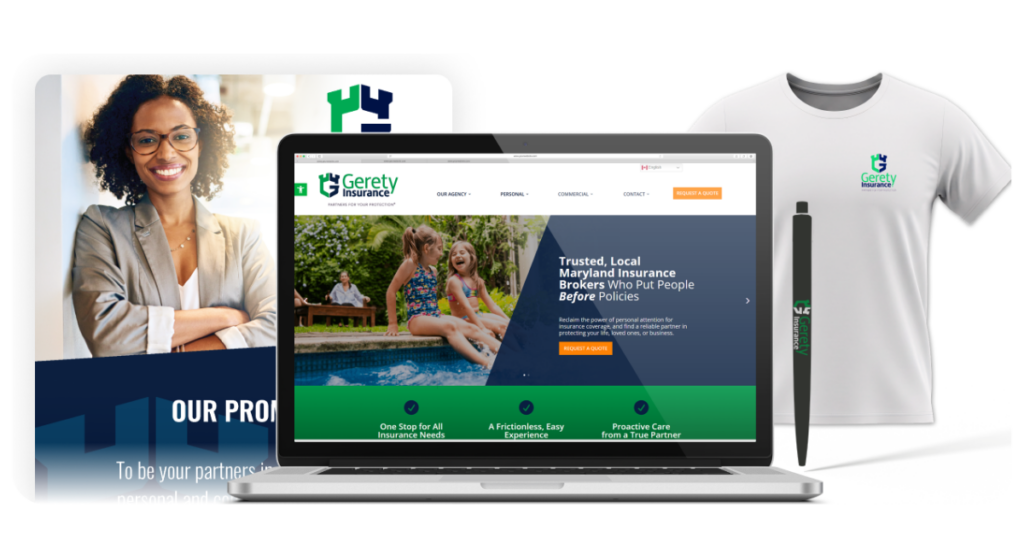
Gerety Insurance is a trusted independent insurance broker with deep roots in Harford County, Maryland. For decades, they built their reputation on personal service, strong local relationships, and a loyal client base. But despite strong word-of-mouth, their marketing wasn't reaching their ideal customers.
They were being treated like a commodity in a price-driven market, competing against national insurance agencies with far larger marketing budgets, and struggling to communicate what truly set them apart.
Gerety's real advantage was their legacy of exceptional service and their deep connection to the community they served. That story just hadn't been told clearly yet.
Brand3 rebuilt the brand around three things Gerety's ideal clients value most:
With that positioning in place, every marketing tactic had a clear direction. Brand3 applied consistent messaging across the website, ads, and social channels, launched SEO and paid campaigns to expand reach, and optimized the site experience to turn interest into action.
The results reflected what happens when positioning and marketing finally work together:
Once their positioning was right, they stopped blending in and became in demand.
Download the full Gerety Insurance case study →
Owning your niche means being unmistakably clear about who you do it for and why that matters.
When your positioning is specific, your message resonates with the right people. When your message resonates, those people find you faster, trust you sooner, and choose you, not because you were the cheapest option, but because you were clearly the right fit. That shift from invisible to in-demand starts with brand strategy, and that’s where we do our best work at Brand3. If you're ready to stop blending in and start owning your niche, schedule a consultation.



MAILING LOCATIONS
1200 Agora Drive
Suite C #307
Bel Air, MD 21014
OFFICE LOCATIONS
Havre de Grace, MD
Lake Stevens, WA